
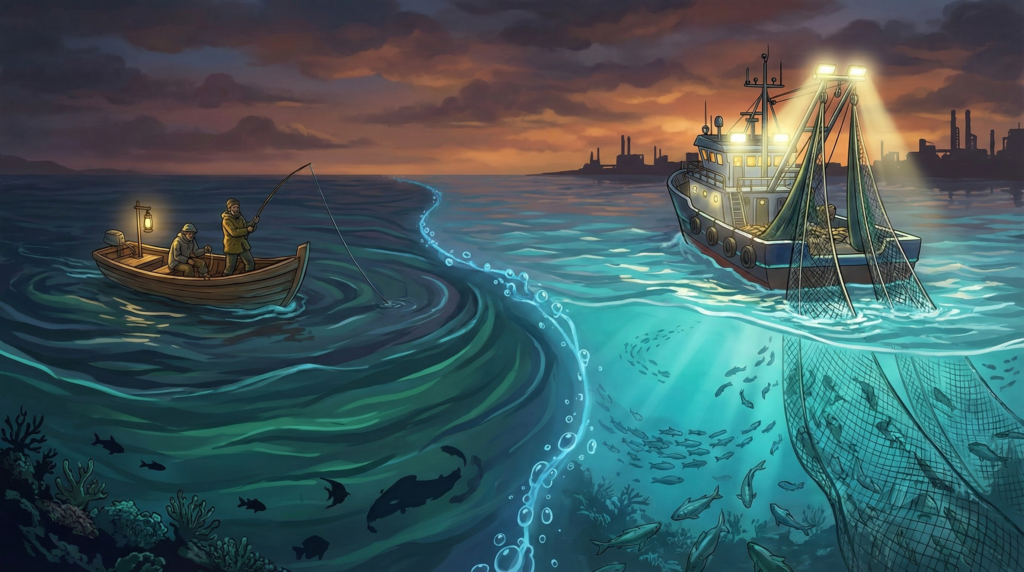
In the pitch-black waters of the Philippine archipelago, a silent war rages every night. On one side, we find the ‘small fry’—subsistence fishermen who navigate these shores with nothing but a handline and a prayer. Yet, just beyond the horizon, loom the commercial giants, whose massive nets can ‘vacuum’ an entire coral reef in a single sweep.

At the heart of this conflict lies a critical legal boundary: the 15-kilometer municipal water limit. This zone serves as a sanctuary for the poor, yet it often becomes a lawless frontier.

Ultimately, this line is where the law meets the lifeblood of the nation; it tests the ‘Social Justice’ promised by the 1987 Constitution—a promise that, for many Filipino mangingisda, remains an empty net.
The Legal Doctrine: Social Justice on the High Seas
The Philippine legal system treats the sea as a communal heritage that requires equitable distribution. Under Article XIII, Section 7 of the Constitution, the State must protect the rights of subsistence fishermen to the preferential use of communal marine and fishing resources .

Our Supreme Court often reminds us that those who have “less in life should have more in law.” In the context of our oceans, this translates into the 15-kilometer limit established by the Philippine Fisheries Code (Republic Act No. 8550). This zone reserves the first 15 kilometers from the shoreline for artisanal fishers, shielding them from the overwhelming mechanical advantages of industrial fleets.
The Fisheries Code operates under several core policy objectives:
Food Security:
The law prioritizes domestic food needs over export-driven commercial fishing to ensure every Filipino family has access to affordable fish.
Preferential Use:
Small-scale fishermen receive priority access to nearshore resources to protect their traditional livelihoods.
Sustainable Development:
The State ensures resources remain available for future generations through strict conservation measures.
Poverty Alleviation:
The government must provide supplementary livelihood and technological support to coastal communities.
Corporate Greed and the Battle for Boundaries: De Borja vs. PUMALU-MV

Even clear boundaries face technical challenges from powerful interests. In the case of De Borja vs. PUMALU-MV (G.R. No. 185320), a commercial operator tried to manipulate how we measure the 15-kilometer limit.

The operator argued for a “Mainland Principle,” suggesting that the 15-kilometer range should only be reckoned from the mainland shore. Small-scale fishers and technical experts argued for the “Archipelagic Principle,” which includes the outer coastlines of offshore islands. The commercial operator’s interpretation would have effectively shrunk the protected territory of small fishermen, allowing industrial boats to move much closer to shore.

The Supreme Court ultimately dismissed the operator’s challenge as premature. This case highlights how “big players” often attempt to tip the scales of justice by exploiting technical ambiguities.
To prevent such frivolous or premature lawsuits, the Court enforces strict requirements for any party seeking “Declaratory Relief” (a court interpretation of a law):
- Justiciable Controversy: A concrete dispute must exist, not just a hypothetical concern or a request for a legal opinion .
- Adverse Interests: The case must involve parties with truly conflicting legal rights .
- Legal Interest: The person suing must have a personal and substantial stake in the outcome .
- Ripeness: The issue must be ready for resolution, meaning the government has already taken an action that directly harms the petitioner .
The Human Cost of Conservation: Tano vs. Socrates
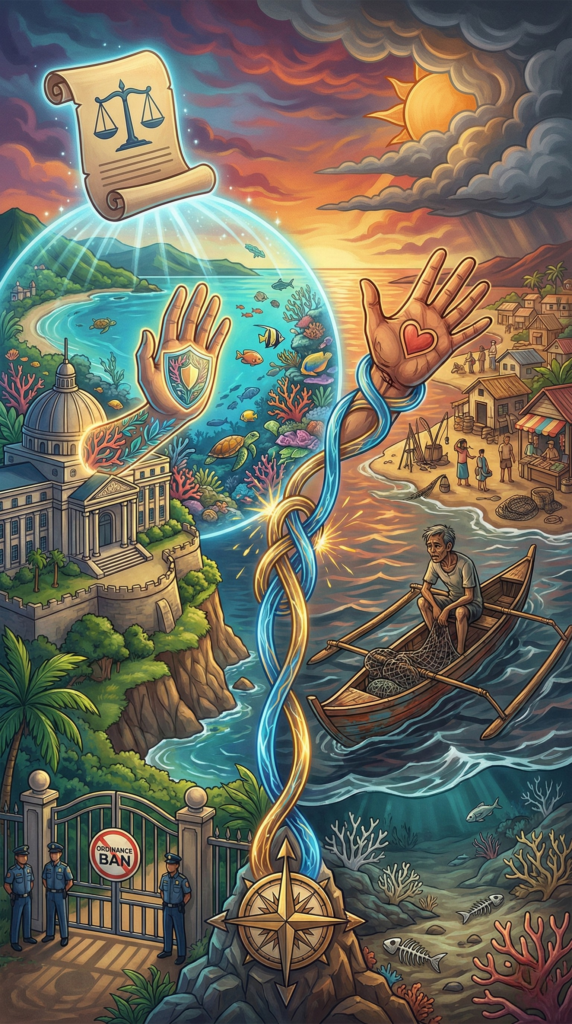
While some battles involve boundaries, others involve the right to work. In Tano vs. Socrates (G.R. No. 110249)
The government passed ordinances in Palawan and Puerto Princesa to protect the environment by banning the shipment of live fish. This case explores the “Police Power” of the State—the power to regulate behavior for the general welfare—against the individual Right to Livelihood.

The Department of Agriculture found that cyanide fishing had destroyed nearly 95% of local coral reefs. To stop the destruction, the local government enacted the following regulations:
To stop the destruction, the local government enacted the following regulations:
Shipment Bans:
Puerto Princesa Ordinance 15-92 banned the shipment of all live fish and lobster (with minor exceptions for fries) for five years.
Species Protection:
Palawan Provincial Ordinance No. 2 prohibited catching or selling eight specific coral-dwelling species.
Enforcement Actions:
Officials received authority to seize shipments lacking the required permits.
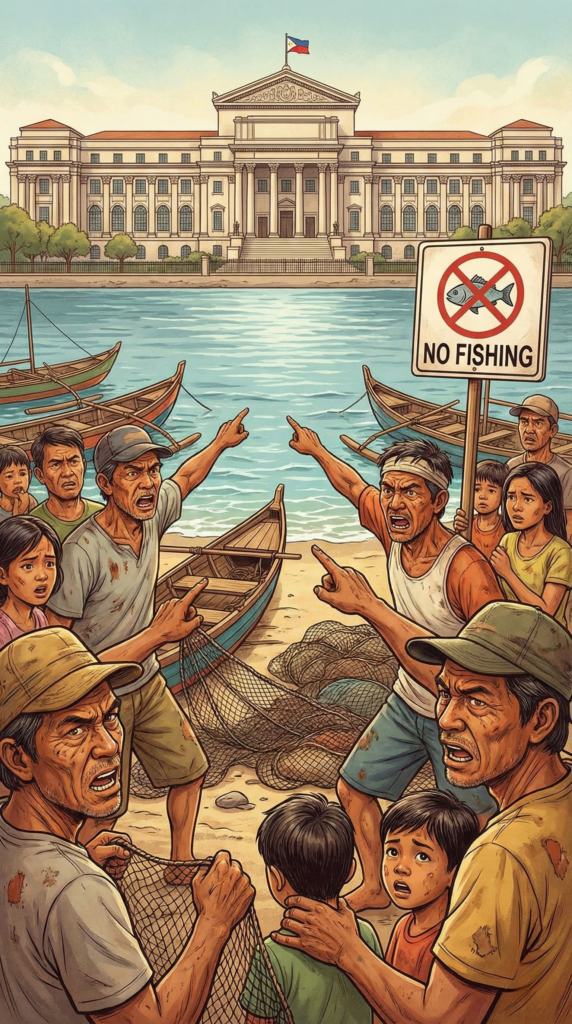
A group of fishermen challenged these rules, arguing they were being starved in the name of the environment.
However, the Supreme Court upheld the ordinances. The Court ruled that local governments have the power and duty to ensure a “balanced and healthful ecology” . While these laws caused short-term hardship, they were necessary to prevent the total collapse of the marine ecosystem. Without the reef, there would eventually be no fish for any fisherman to catch.
Common Misconceptions
Myth 1: The 15-kilometer zone is strictly for small fishers only.
Fact: While the zone is generally reserved for municipal fishers, an LGU may pass an ordinance allowing small and medium commercial vessels to operate between 10.1 and 15 kilometers from the shore. However, this is only allowed if the water is at least 7 fathoms deep and the local Fisheries and Aquatic Resources Management Council (FARMC) approves .
Myth 2: Local governments have no power over “National” waters.
Fact: Although the national government owns our natural resources, the law “devolves” or transfers the management of municipal waters to local municipalities and cities. Local governments have the legal authority to issue permits and enforce environmental bans within their 15-kilometer jurisdiction .
Reclaiming the Sanctuary
The 15-kilometer limit is more than a geographic coordinate; it is a shield for the marginalized. Rulings like De Borja and Tano demonstrate that our courts recognize the need to balance corporate interests and environmental needs against the rights of those who possess the least. If we allow industrial fleets to “vacuum” our nearshore waters, we do not just lose fish—we lose the communities that have stewarded our seas for generations.


Leave a Reply