

Imagine this scenario: After three rounds of intense interviews, you finally receive that coveted job offer. You sign the letter, send it back, and immediately submit your resignation to your current employer. You spend your 30-day notice period dreaming of your new office. Then, just three days before your start date, the new company calls to say they are “withdrawing” the offer due to a change in plans.
In the Philippines, this is more than just a professional heartbreak; it is a significant legal event. Many Filipinos believe that an employer-employee relationship only begins when they physically “time in” on their first day. However, recent Philippine Supreme Court rulings clarify that your rights may begin much sooner than you think.
The Legal Doctrine: Perfection vs. Commencement
Under Philippine law, an employment contract follows the same basic principles as any other contract. It is perfected the moment there is a “meeting of the minds.” This happens when an employer makes a certain offer and the applicant unequivocally accepts it.
The Supreme Court recently underscored this in the landmark case of Paolo Landayan Aragones v. Alltech Biotechnology Corporation (G.R. No. 251736, April 02, 2025). In this case, the Court ruled that an employment relationship was established the moment the employee accepted the job offer, even if the actual start date was months away.
Suspensive Period vs. Suspensive Condition
A common point of confusion is the “start date.” The Court explains that a start date is usually a suspensive period—a certain day that must come. While you cannot demand your salary before that date, the contract itself is already alive and binding. Unless the employer has a “just” or “authorized” cause (like proven redundancy or serious misconduct), they cannot simply change their mind without facing the consequences of illegal dismissal.
When Can an Offer Be Validly Withdrawn?
While the law protects workers, it does not strip employers of their right to set standards. This brings us to the concept of a suspensive condition.
In the case of Enrique Y. Sagun v. ANZ Global Services and Operations (Manila), Inc. (G.R. No. 220399, August 22, 2016), the Supreme Court ruled in favor of the employer. Why? Because the job offer was explicitly conditional. It required a “satisfactory background check.” When the background check revealed material inconsistencies in the applicant’s past employment, the condition was not met. Since the condition failed, the employer’s obligation to hire never became effective.
Key Elements of a Perfected Employment Contract
To determine if you are already legally “hired,” look for these three requisites as provided by the Civil Code and Labor statutes:
- Consent: The employer offers the job, and the applicant accepts it (usually by signing an offer letter).
- Object Certain: The specific position or job description is clearly defined.
- Cause or Consideration: The agreed-upon salary and benefits package.
If these three elements exist, the contract is perfected. For workers recruited for overseas employment, the Omnibus Rules Implementing the Labor Code and RA 10022 provide even stricter layers of protection to ensure that contracts are honored and workers are not left stranded.
Common Misconceptions About Job Offers
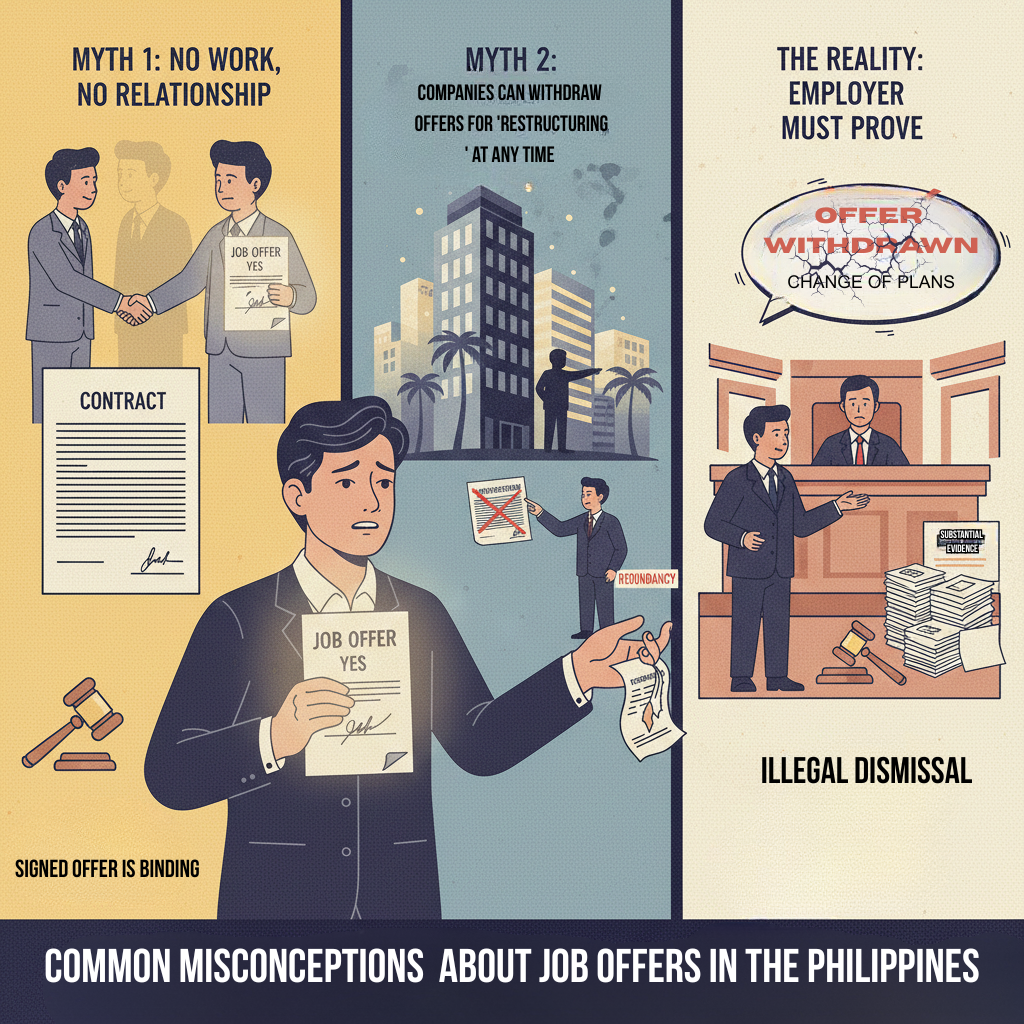
Myth 1: “No work, no relationship.”
The Reality: Many believe that until they sign the “official” multi-page employment contract on Day 1, they aren’t employees. The Supreme Court in the Aragones case clarified that no specific form is required. A signed offer letter containing the essential terms of employment is enough to create a binding relationship.
Myth 2: “Companies can withdraw offers for ‘restructuring’ at any time.”
The Reality: While redundancy is a valid reason to let someone go, the employer must prove it with substantial evidence. In Aragones v. Alltech, the company claimed “global restructuring” but failed to provide solid proof. The Court ruled the dismissal was illegal because the company couldn’t just say “redundancy” without showing the actual financial or organizational necessity.
Summary of Your Rights
If you have signed a job offer and the employer withdraws it arbitrarily:
- Check for Conditions: Was the offer “subject to” a medical exam or background check? If you failed a valid, fair condition, the withdrawal might be legal.
- Verify the Reason: If the withdrawal is due to “redundancy” or “budget cuts,” the company must follow the legal process, including giving notice to the Department of Labor and Employment (DOLE) and paying separation pay.
- Identify the Breach: If the company simply changed its mind or hired someone else after you accepted, you may be entitled to backwages and damages for illegal dismissal.
For more insights on labor rights and workplace regulations, you may explore our other labor law articles.

Leave a Reply