
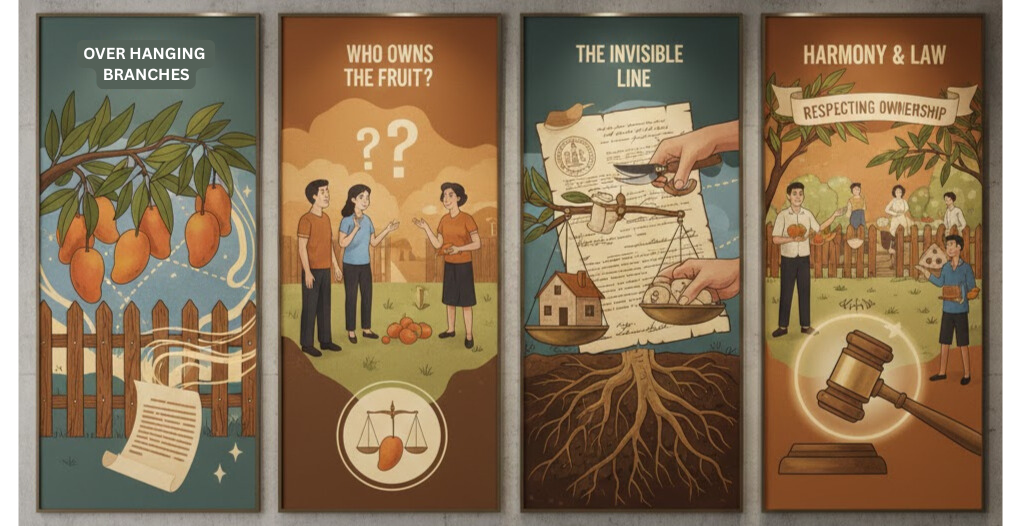
Filipino neighborhoods often feature lush, fruit-bearing trees that provide shade and bounty. However, when a heavy branch of a neighbor’s mango or santol tree dangles over your fence, it frequently sparks a legal debate. Does the physical location of the fruit determine who owns it? Can you harvest what hangs in your yard? Understanding the nuances of Philippine property law helps maintain harmony between neighbors while respecting the “invisible lines” of ownership.
In the Philippines, the Civil Code offers a clear framework for resolving these disputes. This legal structure balances the rights of the tree owner with the interests of the adjacent landowner. By examining the principles of accession, the specific mandate of Article 681, and the protective doctrine of damnum absque injuria, homeowners can navigate these situations with legal clarity and professional dignity.
The Principle of Accession: Alano et al. vs. Ortiz
The primary rule regarding tree ownership rests on the concept of accession continua. In the landmark case of Alano et al. vs. Ortiz (G.R. No. L-6385), the Supreme Court discussed the nature of this principle. The ruling establishes that the owner of the land owns what the land produces. Because the tree is rooted in your neighbor’s soil, the neighbor owns the tree and all its fruits.
The law treats the tree as the “principal” and the fruits as the “accessory.” Under this doctrine, the ownership of the principal dictates the ownership of the accessory. Consequently, even if branches overlap into your yard, the fruit remains the legal property of your neighbor as long as it stays attached to the branch. The boundary line on the ground does not “cut” the ownership of the tree’s biological growth. Therefore, reaching over your fence to pick a dangling fruit constitutes an illegal act.
The Rule of “Natural Fall”: Article 681
While the tree owner maintains primary rights, the Civil Code provides a specific exception for the benefit of the neighbor. Article 681 of the Civil Code states: “Fruits naturally falling upon adjacent land belong to the owner of said land.”
This rule introduces a definitive moment where ownership transfers from the tree owner to the adjacent landowner. However, the law requires strict adherence to the “Natural Fall” requirement. For you to gain ownership of the fruit, it must fulfill these specific conditions:
- Natural Disconnection: The fruit must separate from the tree without human intervention. This includes falling due to wind, gravity, or ripeness.
- Location of the Fall: The fruit must hit your ground. If it falls on the street or back into the owner’s lot, you have no claim to it.
- Absence of Force: You cannot use poles (sungkit), stones, or shaking to induce the fall. If you use any force to make the fruit drop, the law still considers that fruit the property of the tree owner.
Consequently, you must wait for nature to take its course. If you pick the fruit from the branch, the law views this as a form of theft or “usurpation.” The law protects the tree owner’s rights until nature itself severs the connection between the fruit and the tree.
Damage Without Injury: Custodio vs. Court of Appeals
A common source of frustration occurs when a neighbor’s tree causes inconvenience, such as dropping leaves or blocking a view. To address this, we look at the principle of damnum absque injuria (damage without injury). The Supreme Court clarified this concept in Custodio vs. Court of Appeals (G.R. No. 116100).
The Court ruled that a person may suffer “damage” or loss, but if that loss does not result from a violation of a legal right, it does not constitute a “legal injury.” In the Custodio case, petitioners built a fence on their own property, which blocked a neighbor’s access path. While the neighbor suffered a loss (tenants vacating), the Court held that the petitioners were simply exercising their valid property rights.
Applying this to overhanging fruits, you might feel “damaged” because you cannot harvest the fruit in your space. However, since you never owned the fruit while it was on the branch, you have suffered no “legal injury.” Conversely, if you pick their fruit, you are the one committing a legal injury because you have invaded their right of accession. The law affords no remedy for damages resulting from an act that does not amount to a legal wrong.
Common Misconceptions
Misunderstandings about property lines often escalate into heated disputes. Correcting these myths is the first step toward a peaceful resolution.
- Myth: “If it’s in my airspace, it’s mine.” In the Philippines, the rule of accession overrides this logic. The tree owner retains rights to the fruit on the branch regardless of the airspace it occupies.
- Myth: “I can trim the branches myself if they cross the fence.” You do not have the right to take the matter into your own hands. You must first demand that the owner cut the branches. If they refuse, you must seek authority from the court or the Barangay to have them trimmed.
- Myth : “I can shake the branch to get the fruit.”Shaking the branch or hitting it with a stick (sungkit) violates the “natural fall” requirement of Article 681. If you induce the fall, the ownership does not transfer to you; it remains with the tree owner.
Conclusion: Fostering Neighborly Harmony
The law on overhanging fruits seeks to balance the physical reality of nature with the legal reality of property ownership. The principle of accession protects the tree owner’s investment, while Article 681 rewards the neighbor for the inconvenience of falling debris. Most importantly, the doctrine of damnum absque injuria reminds us that living in a community requires a certain level of tolerance for the lawful actions of our neighbors.
By understanding that your rights end where your neighbor’s rights begin, you can avoid unnecessary conflict. If a neighbor’s tree becomes a genuine nuisance, the best course of action involves polite communication or mediation through the Katarungang Pambarangay.
If you are facing a complex property dispute, it is best to consult with a legal professional. For more insights on property protections and civil rights, you can explore our latest legal articles.

Leave a Reply