
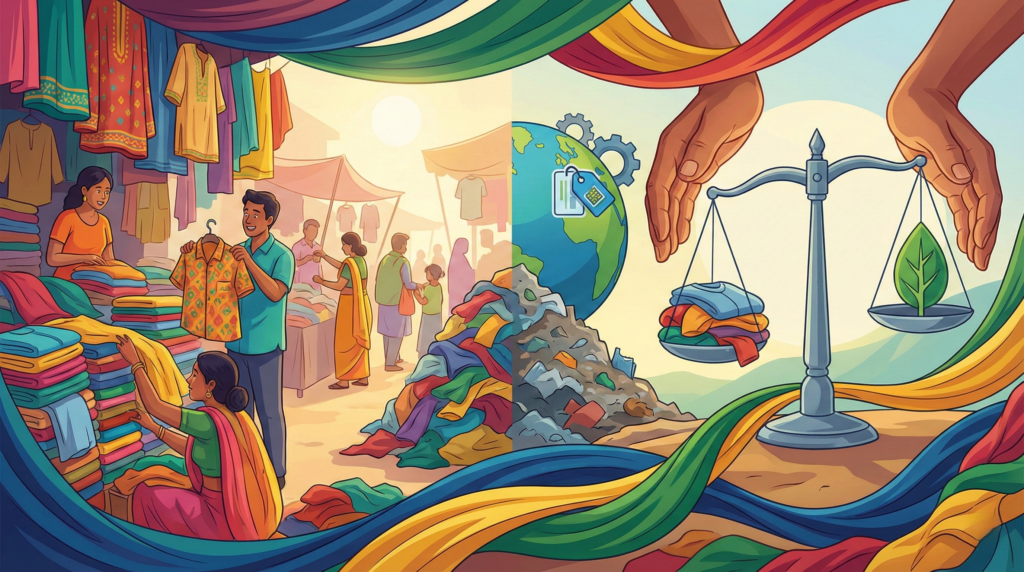
Imagine walking through the vibrant aisles of a local “ukay-ukay” market. You find a designer shirt for a fraction of its retail price. While these markets offer affordability and a unique fashion sense, they also represent a complex legal paradox in the Philippines. Most consumers do not realize that the very existence of these goods often conflicts with national laws designed to protect public health and national dignity.
This issue extends far beyond our borders. Globally, the “War on Fast Fashion” now targets the environmental and social costs of “ultra-fast” fashion giants. Whether through the lens of “waste colonialism” or the implementation of new digital tracking laws in Europe, the legal landscape for textiles is shifting rapidly
The Legal Framework in the Philippines: Republic Act No. 4653
The primary statute governing the entry of used textiles in the Philippines is Republic Act No. 4653. Enacted in 1966, this law declares a national policy to prohibit the commercial importation of used clothing and rags. Congress designed this law to safeguard the health of the Filipino people and maintain the “dignity of the nation” by preventing the country from becoming a dumping ground for the world’s discarded garments.
Key Requisites and Penalties
Under Section 1 of the Act, it is unlawful for any person or corporation to introduce used clothing into the Philippines for commercial purposes. The law provides only narrow exceptions for:
- Donations for charitable or humanitarian purposes, such as disaster relief.
- Items accompanying returning residents as personal effects.
Violators of RA 4653 face significant penalties, including fines ranging from ₱200 to ₱20,000 and imprisonment for two to five years. Furthermore, the law mandates that authorities burn confiscated items in the presence of representatives from the General Auditing Office and the Office of the President to ensure they do not enter the local market.
Jurisprudential Clarification: The Interlink Doctrine
The Philippine Supreme Court clarified the reach of this prohibition in the landmark case of Bureau of Customs v. Interlink Recyclers Philippines, Inc. In this case, a company operating within a Freeport Zone sought to import used clothing for the sole purpose of grading and re-exporting them to other countries.
The Court ruled that the prohibition under RA 4653 applies only within the “customs territory” of the Philippines. Because Freeport Zones are considered “separate customs territories” under Republic Act No. 7227, the Bureau of Customs cannot prohibit the entry of these goods into the zone, provided the items do not enter the domestic market for local sale. This ruling highlights the delicate balance between promoting foreign investment and enforcing national health policies.
The Angle: Waste Colonialism and the “Mitumba” Conflict
While the Philippines fights its internal battle with ukay-ukay, the international community is addressing “waste colonialism”. This term describes a practice where wealthy nations export their textile waste to developing countries under the guise of “donations”.
A powerful case study is the 2016 resolution by the East African Community (EAC) . Countries like Kenya, Rwanda, and Uganda voted to ban the import of second-hand clothing (known as mitumba) to protect their local textile industries . However, this move triggered a trade war. The United States threatened to suspend these nations from the African Growth and Opportunity Act (AGOA), arguing the ban created a trade barrier . Rwanda alone maintained the ban, eventually facing suspension from AGOA benefits in 2018. This demonstrates the legal tension between a nation’s sovereign right to refuse waste and global trade pressures.
The EU’s “Silver Bullet”: Digital Product Passports
To combat the environmental impact of ultra-fast fashion, the European Union (EU) recently enacted Regulation (EU) 2024/1781, also known as the Ecodesign for Sustainable Products Regulation (ESPR). This regulation introduces the Digital Product Passport (DPP), which shifts the legal burden from consumers to producers.
By 2026, the EU will require every garment to feature a scannable digital identity (such as a QR code). This passport will detail:
The overall environmental and carbon footprint of the product.
The material composition and origin of the garment.
Repairability and recycling instructions.
Furthermore, the regulation introduces a “Destruction Ban” .
Starting July 19, 2026, large companies in the EU cannot legally destroy unsold apparel and footwear. They must instead prove they followed a “waste hierarchy” that prioritizes reuse before recycling.
France has gone even further with Bill No. 2129 (2024). This law imposes an “eco-penalty” on ultra-fast fashion items. Starting at €5 per item in 2025, the penalty will rise to €10 by 2030, aiming to hold the most polluting companies financially accountable for their production volume.
Common Misconceptions
Myth 1: Ukay-ukay is legal if the store has a local business permit.
Possessing a business permit from a Local Government Unit (LGU) does not legalize the source of the goods. An LGU permit only signifies compliance with local zoning and tax rules. If the goods were imported commercially in violation of RA 4653, they remain contraband under national law.
Myth 2: “Donated” clothes are always exempt from the ban.
While the law allows for humanitarian donations, importers often abuse this loophole. Smugglers frequently declare commercial shipments as “donations” to clear customs duty-free, only to divert them to retail warehouses. Valid donations must be accompanied by a Certificate of Disinfection and be intended for free distribution to the needy.
The “War on Fast Fashion” requires a multifaceted legal response. In the Philippines, we must reconcile the historical mandate of RA 4653 with the modern economic reality of a multi-billion peso ukay-ukay industry. Simultaneously, the emergence of the EU’s Digital Product Passport and France’s eco-penalties suggests a global shift toward producer accountability and transparency. As the world moves toward a circular economy, the focus of the law is shifting from simply stopping goods at the border to ensuring that every garment has a sustainable journey from “cradle to grave”.


Leave a Reply