

Violence within the Filipino family has historically been viewed through a narrow lens, often limited to visible physical injuries. However, the enactment of Republic Act No. 9262, known as the Anti-Violence Against Women and Their Children Act of 2004, acknowledged a profound truth: the deepest wounds are often those that do not bleed.
Psychological violence—an insidious abuse that pierces the mind rather than the body—is a serious criminal offense punishable by significant imprisonment. Through landmark decisions like Dinamling vs. People and Araza vs. People, the Supreme Court has dismantled the archaic notion that “sticks and stones” are the only weapons that harm. The Court has clarified that actions causing mental anguish, from public humiliation to marital infidelity, constitute vigorous grounds for criminal conviction.
This report provides an exhaustive analysis of the Baya doctrine. We will dissect the constitutional text, the specific factual antecedents of the “Aid to the Poor” program scandal, the intricate “Balancing Test” used by the courts, and the fatal procedural errors that led to the denial of the petitioner’s claims. Furthermore, we will explore the broader implications of this ruling for those involved in CivilLitigation, (https://tamayaolawoffice.com/category/articles/), and public accountability, offering a definitive guide to understanding when a delay is truly a violation of rights, and when it is merely a procedural reality.
The Legal Doctrine: Deconstructing Section 5(i)
To understand the law’s protection, one must grasp the statutory definition. Section 5(i) of RA 9262 punishes acts or omissions that cause or are likely to cause mental or emotional anguish, public ridicule, or humiliation to the woman or her child.
The Supreme Court draws a critical distinction between the Means and the Effect:
- The Means: The specific acts committed by the accused (e.g., verbal abuse, denial of support, infidelity).
- The Effect: The mental or emotional anguish sustained by the offended party.
The law does not punish an act like shouting in isolation; it punishes the act when it is directed at a woman or child with the intent or effect of debasing their dignity.
Case Study I: Dinamling vs. People — Verbal and Situational Abuse
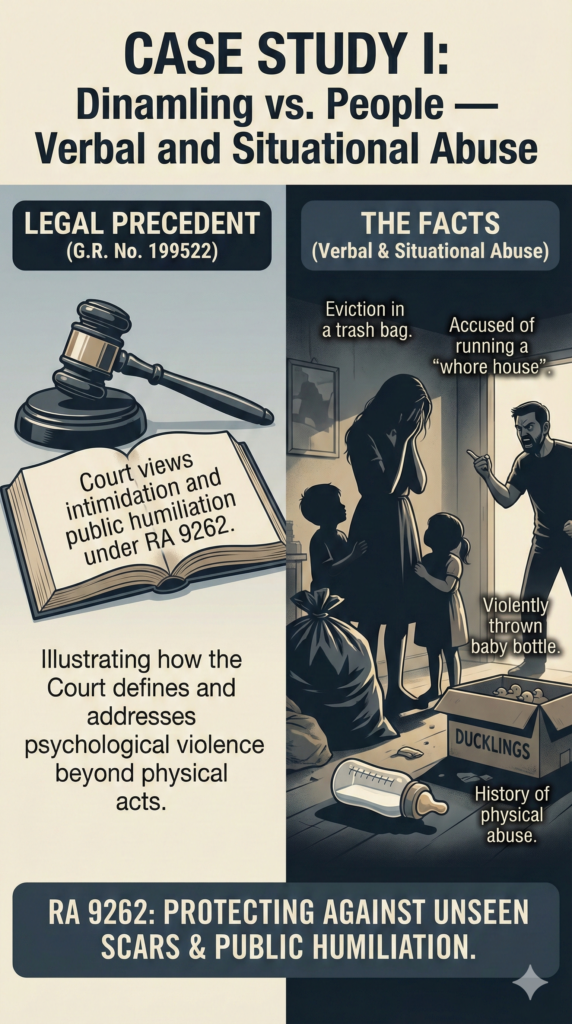
Dinamling vs. People (G.R. No. 199522) stands as a foundational pillar in RA 9262 jurisprudence, illustrating how the Court views intimidation and public humiliation.
The Facts
The petitioner, Ricky Dinamling, went to the boarding house of his partner, “AAA,” and their two children. He began to evict them in a dehumanizing manner, ordering AAA to pack her belongings into a trash bag and a carton box intended for ducklings. He verbally abused her, accusing her of running a “whore house,” and violently threw a baby’s feeding bottle outside. AAA also testified to a history of physical abuse.
The Defense and Ruling
Dinamling attempted to rely on medical technicalities. He argued that because a doctor could not conclusively link AAA’s miscarriage to his physical mauling, he should be acquitted.
The Supreme Court rejected this defense. The Court ruled that proof of physical injury is not indispensable under Section 5(i). The crime was established not by physical marks, but by the mental and emotional anguish AAA suffered due to the public ridicule and degrading treatment. Her testimony regarding the fear and humiliation she felt was sufficient to prove the element of anguish beyond reasonable doubt.
Case Study II: Araza vs. People — Marital Infidelity as Violence
Araza vs. People (G.R. No. 247429) solidified the doctrine that marital infidelity is not merely a civil wrong but a form of psychological violence.
The Facts
Jaime Araza abandoned his wife, “AAA,” to cohabit with his mistress, with whom he fathered three illegitimate children. The mistress actively harassed AAA via text messages. The knowledge of the affair and the abandonment caused AAA severe psychological turmoil, resulting in insomnia, asthma, and the need for antidepressant medication.
The Ruling: Infidelity is Abuse
The Supreme Court affirmed Araza’s conviction, ruling that marital infidelity is a form of psychological violence. The Court found that the specific acts—engaging in an affair and begetting children with another woman—were the proximate cause of the wife’s emotional suffering.
This decision is pivotal because it confirms that infidelity can be prosecuted as a VAWC violation, which often carries higher penalties and easier evidentiary standards than traditional Adultery or Concubinage cases under the Revised Penal Code.
The “No Psychiatrist” Rule
A persistent misconception in VAWC litigation is the belief that a victim requires a clinical diagnosis to prove psychological violence.3 The Supreme Court has decisively dismantled this requirement.
Why No Expert is Needed:
- Personal Experience: Mental anguish is a personal experience; the victim is the best witness to their own suffering.
- Credibility Over Expertise: If the trial court finds the victim’s testimony sincere and categorical, this is sufficient for conviction.
- No “Illness” Requirement: The law requires proof of “anguish,” not a clinical illness like PTSD.
In Araza, the Court emphasized: “To establish emotional anguish or mental suffering, jurisprudence only requires that the testimony of the victim be presented in court.” While medical evidence can corroborate a claim, it is not mandatory.4
Elements of the Crime: A Prosecution Checklist
To secure a conviction under Section 5(i), the following elements must be proven:
| Element | Description |
| 1. The Offended Party | The victim must be a woman and/or her child. |
| 2. The Relationship | The offender must have a sexual/dating relationship with the victim, or they must share a common child. |
| 3. The Act (Means) | The offender commits acts such as ridicule, verbal abuse, denial of support, or infidelity. |
| 4. The Effect | The acts resulted in mental or emotional anguish for the victim. |
Common Misconceptions vs. Legal Reality
- Myth: “I cannot file a case without a psychiatrist’s report.”
- Fact: False. Victim testimony is sufficient to prove emotional anguish.
- Myth: “He didn’t hit me, so it’s not violence.”
- Fact: False. Verbal abuse, humiliation, and psychological torment are criminal acts under RA 9262.
- Myth: “It’s just a domestic quarrel.”
- Fact: False. When a quarrel debases a woman’s dignity, it becomes a crime against the State.
Conclusion
The Supreme Court’s decisions in Dinamling and Araza serve as beacons of justice. They clarify that the Philippine justice system takes the mental well-being of women and children as seriously as their physical safety.
By recognizing marital infidelity and verbal degradation as criminal acts, and by removing the barrier of expensive psychiatric evaluations, the law has opened the doors of justice to silent victims. The message is unequivocal: Violence is defined not by the weapon used, but by the harm inflicted.


Leave a Reply