

In the high-stakes arena of Philippine civil litigation, few mechanisms wield as much power—or carry as much procedural risk—as the Writ of Preliminary Attachment. Rule 57 of the Rules of Court governs this provisional remedy. It empowers a plaintiff to legally seize and encumber an adverse party’s property before a court renders judgment. This seizure secures the satisfaction of a potential future judgment.
However, because this remedy freezes assets before a trial on the merits, the Supreme Court consistently characterizes it as a “harsh, extraordinary, and summary remedy”. The Court views it not as a matter of right, but as a statutory privilege. Consequently, the High Court enforces a doctrine of strict construction. Judges must resolve any ambiguity in the rules or deficiency in the allegations against the applicant and in favor of the defendant.
The Nature and Concept of the Writ
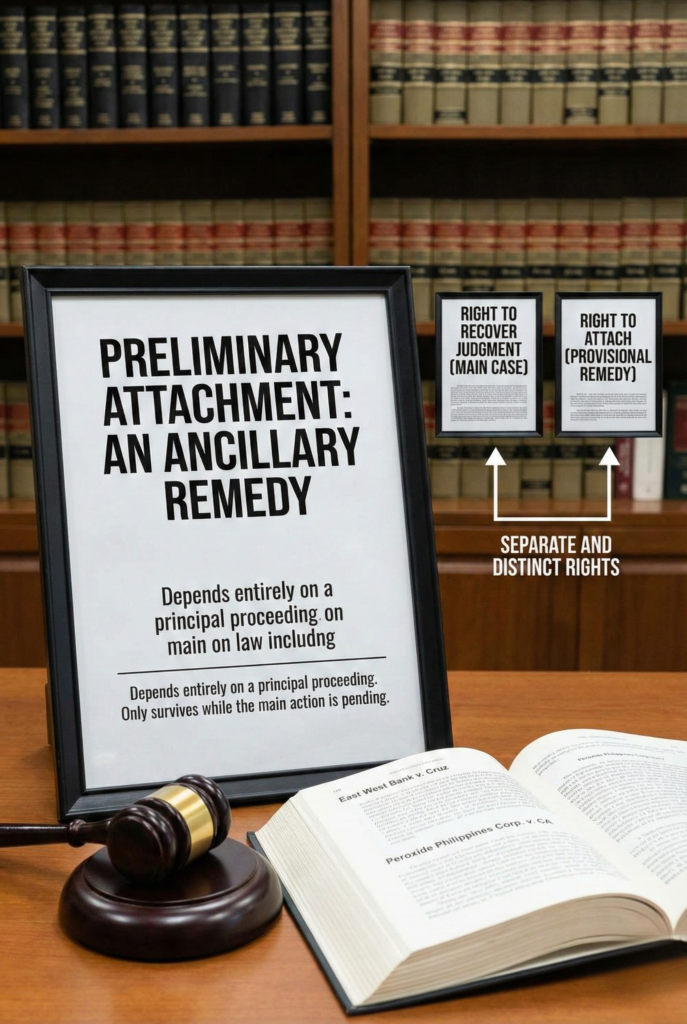
Preliminary attachment does not exist for its own sake. The law considers it an ancillary remedy that depends entirely on a principal proceeding. Whether the plaintiff files a collection suit or a fraud allegation, the attachment survives only as long as the main action remains pending.
Crucially, the “right to recover judgment” (the main case) and the “right to attach” (the provisional remedy) function as separate and distinct rights. As the Supreme Court clarified in East West Bank v. Cruz and Peroxide Philippines Corp. v. CA, a court may deny the attachment due to technical defects while still finding the defendant liable for the debt in the final decision.
The Doctrine of Specificity
To prevent abuse, the Supreme Court rejects general averments. In the landmark case of D.P. Lub Oil Marketing Center, Inc. v. Nicolas, the Court struck down an attachment because the affidavit merely parrot-phrased the Rules. A plaintiff cannot simply claim the defendant “committed fraud”; the plaintiff must allege the specific who, what, where, and how of the fraudulent act.
Part II: The Statutory Grounds (Rule 57, Section 1)
The grounds for attachment are exclusive. If a case does not fall within the six categories listed in Rule 57, Section 1, the court cannot issue the writ.
Departure with Intent to Defraud: This applies against a party who intends to depart the Philippines with the specific purpose of defrauding creditors. Mere departure (e.g., a foreigner returning home) proves nothing; the plaintiff must prove a plan to escape liability.
Embezzlement/Fiduciary Breach: This applies in actions for money or property that a public officer, corporate officer, agent, or fiduciary embezzled or misappropriated.
Concealed Property: This applies in Replevin cases where the defendant hides the specific chattel to prevent seizure.
Fraud in Contracting or Performance: Litigants use this ground most frequently. It applies when the defendant contracted the obligation through fraud (causal fraud) or fraudulently evades performance.
Dissipation of Assets: This targets a party who removes or disposes of property with the intent to defraud creditors.
Non-Residents: This applies against a party who does not reside and is not found in the Philippines. The court needs this to acquire jurisdiction over the property.
Jurisprudential Spotlights
In Watercraft Venture Corp. v. Wolfe, the Supreme Court ruled that the lower court improvidently issued a writ against a British national. The plaintiff argued that the defendant posed a flight risk because he was a foreigner with no real property in the Philippines. The Court rejected this argument. It held that residency status alone does not prove fraud. The plaintiff failed to cite specific acts that proved an intent to abscond or defraud.
The “Coca-Cola” Doctrine: Rejection of Standby Letters of Credit (SBLC)
In Coca-Cola Femsa Philippines, Inc. v. Pacific Sugar Holdings Corp., the defendant attempted to substitute the attached assets with a Standby Letter of Credit (SBLC). The Supreme Court rejected this and applied strict textualism. The Rules explicitly mention “counter-bond” but not “SBLC.” The Court noted that an SBLC often acts as a guarantee (which requires the plaintiff to exhaust the debtor’s assets first) rather than a surety (which creates direct liability). This makes the SBLC more onerous for the plaintiff. Thus, courts do not accept SBLCs as valid substitutes for counter-bonds.
Criminal Cases (Rule 127)
Rule 127 makes preliminary attachment available in criminal cases. When the government institutes a criminal action, the law deems the civil action for the recovery of civil liability instituted with it.
- Estafa and Malversation: In crimes involving fraud or embezzlement, the grounds for attachment often align perfectly with the elements of the crime.
- Due Process: While the law presumes the accused innocent, the court may attach their assets to secure the civil liability (restitution). The plaintiff must still meet the requisites of Rule 57.
Risk Assessment and Mitigation
Applying for a writ involves significant risk. If the court later finds the applicant lacked entitlement to the writ, the applicant (and their surety) becomes liable for all damages the defendant sustained.
| Risk Level | Legal Issue | Mitigation Strategy |
| High | Defective Affidavit | Avoid “perfunctory” recitals. Draft the Affidavit of Merit with specific dates, amounts, and acts of fraud (D.P. Lub Oil). |
| High | Improper Bond | Post a bond strictly in the amount the court fixed, using an accredited surety. |
| Medium | SBLC Offer | Reject Standby Letters of Credit. Insist on a Cash Deposit or Surety Counter-bond (Coca-Cola Femsa). |
| Medium | Flight Risk (Foreigners) | Do not rely on citizenship. Prove specific acts of asset liquidation or flight preparation (Watercraft). |
Preliminary attachment acts as a double-edged sword. When a plaintiff uses it correctly, it prevents a paper judgment from becoming a pyrrhic victory. When a plaintiff uses it recklessly, it exposes them to counter-suits for damages.
The Supreme Court sends a clear message: Strict compliance is non-negotiable. Whether you stand as a creditor seeking to freeze assets or a defendant fighting to unlock business accounts, success hinges on a granular understanding of Rule 57’s technical requirements. In the landscape of Philippine litigation, general allegations serve as the enemy; specificity acts as your only shield.
Please remember that this post is intended for general informational purposes only and does not, in any way, constitute legal advice. Every situation is unique, and you should always consult a qualified lawyer for professional advice regarding your specific concerns. The scenarios and examples provided in this article are purely fictional and for illustrative purposes only and are not based on any actual case or controversy.


Leave a Reply