
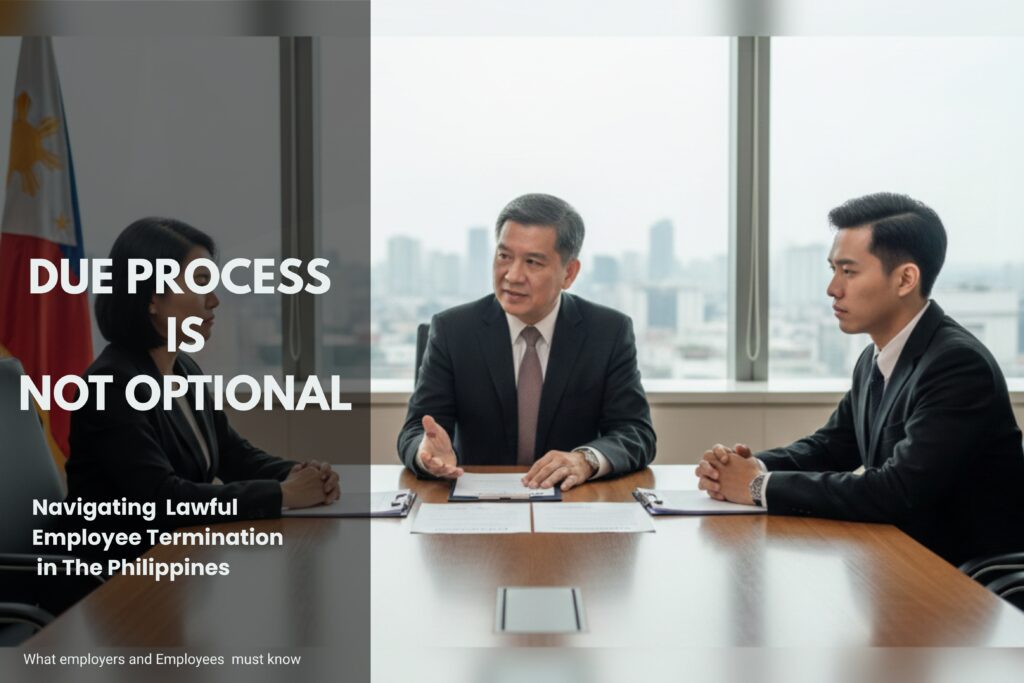
Imagine a business owner discovering clear evidence of misconduct by a trusted employee. The natural instinct is to implement immediate separation to safeguard the company. However, in the Philippines, acting on instinct alone can be a costly mistake. Without meticulously following statutory procedures, a justified separation can transform into an illegal dismissal. This subjecting the business to significant financial liabilities, including backwages and damages.
This reality underscores a critical truth: the viability of any enterprise in the Philippines rests on strict labor compliance. Unlike other jurisdictions that permit “at-will” employment, Philippine labor law is rooted in the constitutional mandate to protect labor. This grants employees the fundamental right to security of tenure.
The Legal Doctrine of Security of Tenure
The foundation of the employer-employee relationship in the Philippines is the principle of security of tenure. This doctrine assures that employees can only be separated for causes explicitly defined by the Labor Code. These are classified as either Just Causes (employee’s fault) or Authorized Causes (business or health necessity).
Even with a valid reason, failure to observe due process renders the dismissal procedurally illegal. In the landmark case of Amor, et al. v. Constant Packaging Corporation (G.R. No. 259988, May 19, 2025), the Supreme Court reiterated that preventing employees from entering the workplace without a valid reason or following due process constitutes illegal dismissal. Management must therefore diligently observe distinct rules for each type of cause
Termination for Just Causes (Employee Fault)
Just Causes involve acts or omissions directly attributable to the employee. Under Article 297 (formerly 282) of the Labor Code, these include:
- Serious Misconduct or Willful Disobedience: The order must be lawful, reasonable, and work-related.
- Gross and Habitual Neglect of Duties: Reckless disregard or repeated failures over time.
- Fraud or Willful Breach of Trust: Typically applies to positions of trust and confidence.
- Commission of a Crime: Against the employer, their family, or representatives.
- Analogous Causes: Similar in nature to the above.
The Requisites of the Twin Notice Rule
To legally terminate for Just Causes, an employer must follow a three-step protocol designed to give the employee an opportunity to be heard.
- First Written Notice (Notice to Explain): This formally charges the employee. It must contain specific grounds, a detailed narration of facts, and a directive granting at least five (5) calendar days to respond.
- Hearing or Conference: The employer must conduct a hearing to allow the employee to present evidence or rebut the charges.
- Second Written Notice (Notice of Decision): This informs the employee of the outcome, confirming that all circumstances were considered and the grounds were established.
Termination for Authorized Causes (Business Necessity)
Authorized Causes are non-punitive and arise from legitimate business requirements. These include:
- Redundancy: When a position is superfluous to the business needs.
- Retrenchment: To prevent serious business losses.
- Installation of Labor-Saving Devices: Introduction of machinery that replaces human labor.
- Closure of Business: Cessation of operations not due to serious losses.
- Disease: When an employee’s continued employment is prejudicial to their health or co-workers, certified by a public health authority.
The Requisites of the 30-Day Notice
For Authorized Causes, the law requires a different procedural approach:
- Advance Written Notice to the Employee: Served at least thirty (30) days before the intended termination date.
- Advance Written Notice to the DOLE: A copy must be submitted to the Department of Labor and Employment (DOLE) concurrently.
- Payment of Separation Pay: Usually equivalent to at least one-half (1/2) or one (1) month pay for every year of service, depending on the specific cause.
Common Misconceptions to Avoid
Understanding jurisprudence helps businesses avoid mistakes based on widespread myths:
Myth: If an employee committed a clear crime, you can fire them on the spot. Correction: This is incorrect. Even if the misconduct is documented, the Supreme Court has held that failure to observe the Twin Notice Rule renders the dismissal procedurally defective. In such cases, while the dismissal might be justified, the employer may still be liable for nominal damages (typically P30,000 to P50,000) for the procedural lapse.
Myth: Omitting a previous job in an application is always a ground for dismissal. Correction: Not necessarily. In Celis v. Bank of Makati (G.R. No. 250776), the Court ruled that the mere omission of past employment, without intent to deceive on a material qualification, is not enough to justify termination. The penalty must always be commensurate with the offense.
Lawful employee termination in the Philippines is a technical exercise in procedural integrity. Because security of tenure is a protected right, the burden of proof rests entirely on the employer to demonstrate both substantive cause and procedural compliance.
Proactive internal auditing and rigorous adherence to the multi-step due process rules are essential for risk mitigation. Navigating this landscape requires discipline and an institutional commitment to best practices.
For proper guidance on labor concerns, human resource policy drafting, and procedural compliance specific to your business context, it is best to consult with a legal professional.
Leave a Reply