

The “Ber” Months Are a Legal Minefield
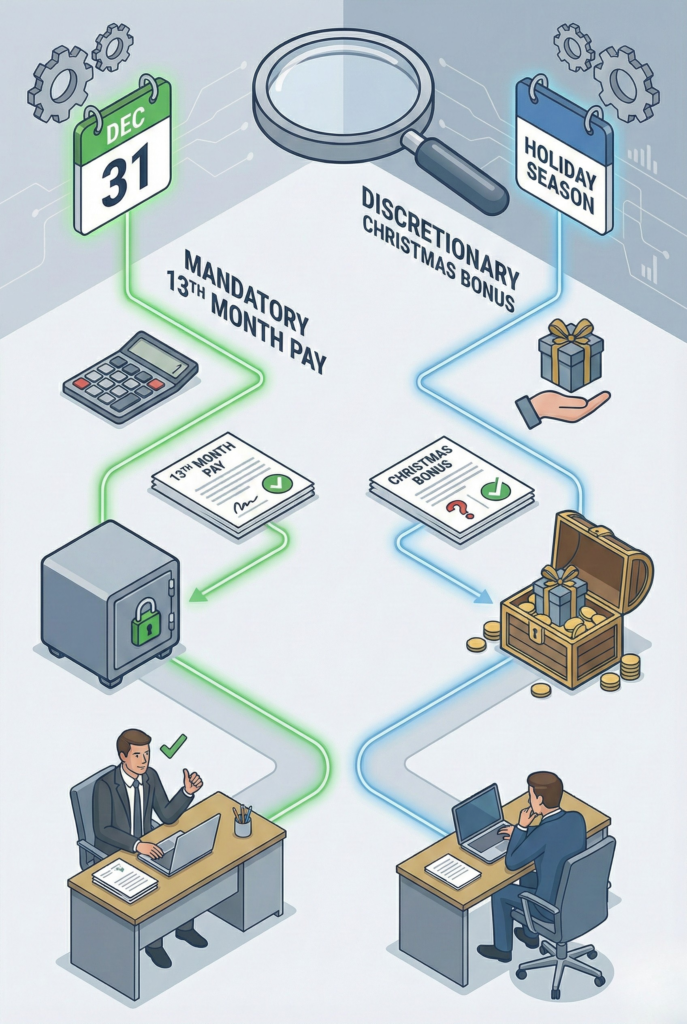
In the Philippines, the “Ber” months do not just signal the start of the holidays; they signal the start of your biggest financial and legal exposure. For you, the employer, this is not merely a season of giving. It is a season of compliance.
Do not mistake the Christmas season for a simple holiday break. It is a strict regulatory event governed by Presidential Decree No. 851 and a minefield of Supreme Court rulings. One miscalculation in your payroll, or one carelessly drafted memo about a “Christmas Bonus,” can trigger a lawsuit for illegal diminution of benefits or non-payment of wages.
You must navigate two distinct concepts: the Mandatory 13th Month Pay and the Discretionary Christmas Bonus. Confuse them, and you risk binding your company to a lifetime obligation you cannot afford.
The Non-Negotiable Debt: 13th Month Pay
Let us be clear: You have no choice regarding the 13th Month Pay. This is not a gift. It is a debt you owe to your workforce.
Presidential Decree No. 851 mandates this payment to protect real wages from inflation. Originally, the law covered only those earning less than P1,000, but Memorandum Order No. 28 removed this ceiling. Today, you must pay this to all rank-and-file employees, regardless of their salary rate.
Who Must You Pay?
You must pay every rank-and-file employee who has worked for at least one (1) month during the calendar year.
• Regular employees
• Probationary staff
• Casual workers
How Much Do You Pay?
You must calculate exactly one-twelfth (1/12) of the employee’s basic salary earned within the calendar year.
• Do not include overtime pay, profit-sharing, or allowances in this calculation unless you want to overpay voluntarily.
• Do not delay. You must release this payout no later than December 24.
If you fail to pay this, you expose yourself to administrative complaints and potential labor litigation.
The Dangerous Trap: The “Christmas Bonus”
Here is where you must worry. While the 13th Month Pay is a fixed formula, the Christmas Bonus is a legal trap for the unwary employer.
Legally, a bonus is an act of generosity or liberality. It is management prerogative. You grant it to reward industry and loyalty, or to share profits. Because it is voluntary, the general rule is that you can withdraw it when your business suffers.
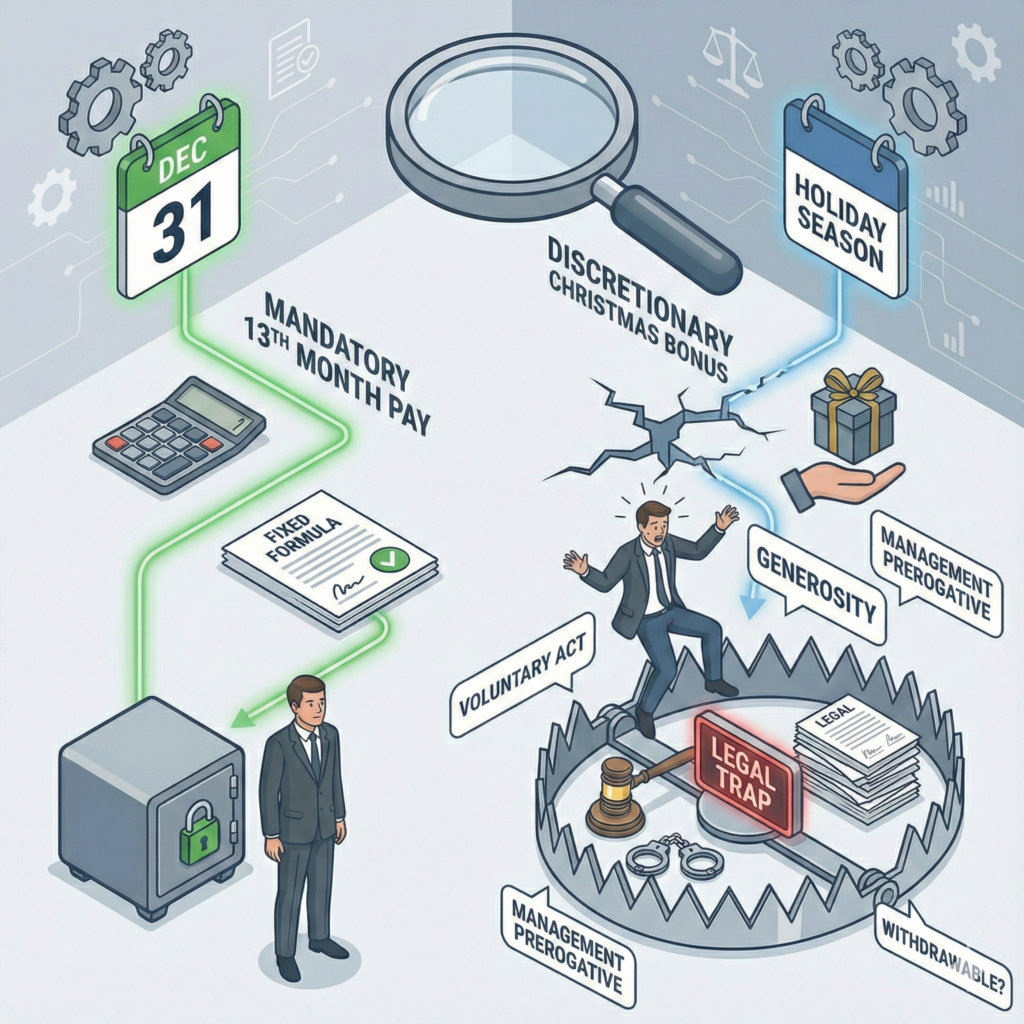
However, you can lose this right.
In Eastern Telecommunications Philippines, Inc. v. Eastern Telecoms Employees Union, the Supreme Court ruled against an employer that attempted to withhold 14th, 15th, and 16th-month bonuses due to reported business losses. The employer’s fatal mistake was signing a Side Agreement to the Collective Bargaining Agreement that explicitly stated the bonuses “are granted” without any qualifying language conditioning the payment on profitability. The Court held that this unconditional stipulation, reinforced by the company’s history of paying the bonuses even during previous loss-making years, converted the benefit from a discretionary act of generosity into a demandable contractual obligation that could not be unilaterally withdrawn, regardless of the company’s financial downturn.
The Liability of Unconditional Contracts
In G.R. No. 185665 – Eastern Telecommunications, the employer faced a nightmare. The company had a tradition of giving 14th, 15th, and even 16th-month bonuses. They formalized this in a “Side Agreement” to their Collective Bargaining Agreement (CBA).
The Defense of Legal Insolvency
In contrast, the Court ruled in favor of the employer in Producers Bank Of The Philippines, Vs. National Labor Relations Commission And Producers Bank Employees Association. In this case, the bank suspended its traditional mid-year and Christmas bonuses while under conservatorship by the Central Bank. The Court distinguished this situation from simple business losses, establishing the doctrine that “generosity cannot be exacted from empty coffers.” Because the bank was legally insolvent and under receivership, the preservation of assets took precedence over non-wage benefits. The Court held that since the bonuses were not integrated into the basic salary and the company was in a state of financial collapse, the employees could not demand payment based on the principle of “company practice”.
The Supreme Court ruled in favor of the employer.
• Why? The Court declared that “generosity cannot be exacted from empty coffers”. Because the bonus was not part of the basic salary and the bank proved it was legally insolvent, the employees could not demand it.
• The Lesson: Your best defense against a “vested right” claim is proof of substantial financial loss, combined with a clear record that the bonus was always discretionary.
The Strategy: Avoiding the “Fixed Amount” Trap
In American Wire And Cable Daily Rated Employees Union, Vs. American Wire And Cable Co., Inc. And The Court Of Appeals, the union demanded the continuation of a Christmas Party and other perks. The employer won because the Court found these benefits were not “fixed amounts” and were not written in the CBA.
- The Lesson: Keep your bonuses variable. If you pay exactly “P10,000” every December for 10 years, it looks like a salary. If you pay based on a percentage of varying profits, it looks like a true bonus.
5 Rules to Protect Your Business
To ensure you survive the Christmas season without a labor lawsuit, follow these rules:
Know the Tax Limits: Remember that 13th-month pay and other benefits are only tax-exempt up to P90,000. You must withhold tax on anything above this.
Segregate Your Payslips: Clearly label the “13th Month Pay” and the “Christmas Bonus.” Do not lump them together. You need proof you paid the mandatory benefit.
Draft Contracts Carefully: When offering a bonus in an employment contract or CBA, always add the phrase: “This bonus is discretionary and contingent upon the company realizing a profit.”
Document Your Losses: If you cannot afford a bonus this year, you must have audited financial statements ready to prove your “financial distress”. Mere verbal claims of “low sales” will not stand in court.
Do Not Create Precedents: Be cautious about giving the exact same amount at the exact same time for years. Variation protects the discretionary nature of the gift.
Be Generous, But Be Smart
The law expects you to share the fruits of your labor, but it does not require you to bleed your company dry. The 13th Month Pay is your duty; the Christmas Bonus is your option.
Do not let your guard down. Review your employment contracts and CBAs today. Ensure that your acts of kindness do not turn into legal shackles. If you are unsure whether your “traditional” bonus has already become a “vested right,” you need to assess your risk immediately.
For guidance on other labor concerns, such as handling labor disputes or understanding illegal dismissal risks , ensure your policies are legally sound.
Please remember that this post is intended for general informational purposes only and does not, in any way, constitute legal advice. Every situation is unique, and you should always consult a qualified lawyer for professional advice regarding your specific concerns. The scenarios and examples provided in this article are purely fictional and for illustrative purposes only and are not based on any actual case or controversy.


Leave a Reply