
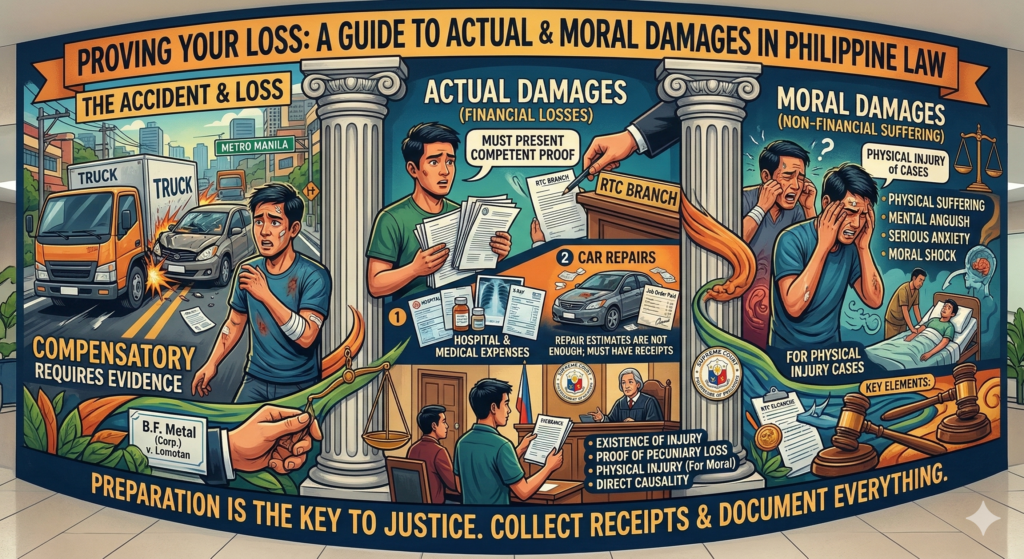
Imagine driving along a busy thoroughfare in Metro Manila when a delivery truck suddenly swerves into your lane, causing a significant collision. Beyond the initial shock, you now face mounting hospital bills, expensive car repairs, and the emotional trauma of the event. In the Philippines, the law allows you to seek compensation for these burdens, but many Filipinos find the process of “claiming damages” confusing or intimidating.
Understanding how the Supreme Court treats these claims is essential for anyone seeking justice. Whether you are dealing with a vehicular accident or a different type of personal injury, knowing what the law requires can make the difference between a successful claim and a dismissed case.
The Legal Doctrine: Compensation Requires Evidence
In Philippine law, “damages” refer to the sum of money which the law awards or imposes as pecuniary compensation, recompense, or satisfaction for an injury done or a wrong sustained. However, the courts do not hand out these awards simply because an accident happened. You must prove your losses with a high degree of certainty.
The Supreme Court, in the case of B.F. Metal (Corporation) v. Lomotan, et al. (G.R. No. 170813, 2008), emphasized a fundamental rule: actual or compensatory damages must be supported by competent proof. You cannot rely on mere guesswork or speculation. If you seek reimbursement for money spent, you must show the court exactly where that money went.
Similarly, the case of Caravan Travel and Tours International, Inc. v. Abejar (G.R. No. 170631, 2016) reinforces the responsibility of parties to establish the factual basis of their claims. These rulings serve as a reminder that while the law protects victims, it also requires them to be diligent in documenting their losses.
The Two Pillars of Your Claim
When filing a case for a “quasi-delict” (a legal term for negligence that causes damage), claimants typically focus on two main types of damages: Actual Damages and Moral Damages.
1. Actual or Compensatory Damages
These damages cover the “pecuniary” or financial loss that you have actually suffered and can prove. The law intends to put you back in the financial position you were in before the injury occurred.
According to the ruling in B.F. Metal (Corporation), you must meet the following requirements to recover actual damages:
- Competent Evidence: You must present official receipts, invoices, or billing statements.
- Specific Documentation for Vehicles: For car repairs, the court expects job orders and proof of payment for both parts and labor.
- Medical Accuracy: For physical injuries, you must provide hospital receipts, diagnostic test results, and prescriptions paired with their corresponding purchase receipts.
2. Moral Damages
Moral damages are different because they do not have a fixed price tag. Instead, they compensate for non-financial injuries. As defined by the Civil Code of the Philippines (1949), these include:
- Physical suffering
- Mental anguish
- Fright and serious anxiety
- Besmirched reputation and wounded feelings
- Moral shock and social humiliation
Under the law, you can recover moral damages in cases of quasi-delicts that cause physical injuries. However, the claimant must prove that they truly experienced the kind of injury contemplated by the law.
Key Elements for a Successful Claim
To successfully pray for damages before a Philippine court, a claimant generally needs to establish these elements:
- The Existence of an Injury: You must show that a legal wrong occurred.
- Proof of Pecuniary Loss (for Actual Damages): You must present “competent proof.” The court will likely deny or reduce your claim if you only present quotations or estimates without actual receipts.
- The Presence of Physical Injury (for Moral Damages): In most accident cases, the law requires physical injury as a prerequisite for awarding moral damages.
- Causality: You must demonstrate that the defendant’s negligence directly caused your suffering or financial loss.
Common Misconceptions About Damages
Myth 1: “A repair estimate is enough to get paid.”
Many people believe that getting a quote from a mechanic is sufficient to claim the cost of repairs. This is incorrect. As the Supreme Court ruled in B.F. Metal (Corporation), estimates alone are insufficient. The court requires “competent evidence,” meaning actual receipts for work already performed or parts already purchased. Projected costs are often dismissed as speculative.
Myth 2: “I am automatically entitled to moral damages if I am in an accident.”
While accidents are traumatic, the law does not automatically grant moral damages. You must prove that the accident falls under the specific categories mentioned in the Civil Code—such as a quasi-delict causing physical injury—and you must provide testimony or evidence regarding your mental anguish or physical suffering.
Conclusion: Preparation is the Key to Justice
Seeking justice in the Philippines requires more than just being “right”; it requires being prepared. The Supreme Court’s rulings in B.F. Metal and Caravan Travel and Tours highlight that the judiciary values concrete evidence over emotional pleas. If you find yourself in a situation where you must sue for damages, start collecting your documents immediately. Keep every receipt, secure every medical report, and document the timeline of your recovery.
By understanding these legal doctrines, you empower yourself to navigate the Philippine legal system with confidence and clarity.
Need Further Guidance?
Navigating the complexities of the Civil Code and Supreme Court jurisprudence requires professional expertise. If you need assistance in evaluating your claim or documenting your losses, we recommend consulting with a qualified legal professional to ensure your rights are protected.
For more insights into Philippine law and recent legal developments, feel free to explore our other articles and legal guides.

Leave a Reply