
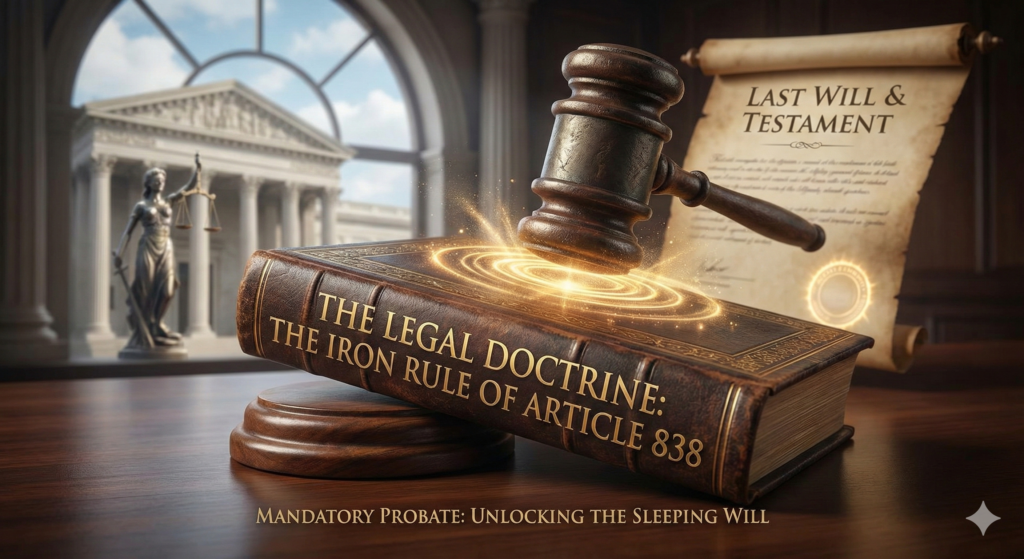
Introduction: The “Hidden Will” Scenario
Imagine a common scenario: A family patriarch passes away, leaving behind a substantial estate and a Last Will and Testament. The heirs read the will and discover that the process to enforce it—Probate—requires court hearings, lawyer fees, and time. To save money and avoid hassle, they make a pact: “Let’s just keep the will a secret. We are all in agreement anyway. Let’s sign an Extrajudicial Settlement instead and divide the property equally.”
This sounds practical, efficient, and harmonious. However, under Philippine law, this agreement is legally defective and potentially void.
In the Philippines, the “voice from the grave” cannot be silenced by a private agreement among the living. The probate of a will is not a suggestion; it is a strict jurisdictional requirement. Attempting to bypass it can lead to clouded titles, future litigation, and criminal liability.
The Legal Doctrine: The Iron Rule of Article 838
The foundation of probate law in the Philippines is Article 838 of the Civil Code, which issues a prohibitory command:

“No will shall pass either real or personal property unless it is proved and allowed in accordance with the Rules of Court.”
This provision is absolute. It means that a will, no matter how beautifully written or perfectly notarized, is legally “asleep” until a judge “awakens” it through a decree of allowance. Without this judicial stamp of approval, the Register of Deeds cannot transfer land titles, and banks cannot release funds to the named executor.
What the Supreme Court Says
The Supreme Court has consistently upheld this mandatory nature, most notably in the landmark case of Roberts vs. Leonidas (G.R. No. 55509, 1984).
In Roberts, the heirs attempted to settle an estate extrajudicially despite the existence of a will. They argued that since there were no debts and everyone agreed, the will was “surplusage” (unnecessary). The Supreme Court struck this down, ruling that the probate of wills is mandatory. The Court emphasized that the right of a person to dispose of their property is a statutory right that the state protects. If heirs were allowed to ignore a will by mere agreement, they would effectively be rewriting the testator’s legacy, violating the owner’s intent.
Furthermore, once a probate decree becomes final, it is conclusive. As established in Gallanosa vs. Arcangel (G.R. No. L-29300, 1978), a final judgment in probate proceedings is res judicata. This means the validity of the will—specifically its due execution and the testator’s capacity—cannot be re-litigated. This doctrine of finality provides a permanent “shield” for the heirs, ensuring that the property rights they acquire are secure against future challenges.
Key Elements of Mandatory Probate
To comply with the law, specific requisites must be met under Rules 75-92 of the Rules of Court:
- Jurisdictional Nature (In Rem): Probate is an action in rem, meaning it is a proceeding against the estate itself, binding the whole world. This is achieved through Publication of the notice of hearing in a newspaper of general circulation for three consecutive weeks.
- Production of the Will: The person who has custody of the will is legally obligated to deliver it to the court within twenty (20) days of the testator’s death (Rule 75). Withholding a will is not just a civil violation; it violates public policy.
- Proof of Authenticity:
- For Notarial Wills, the subscribing witnesses and notary public must testify (unless uncontested).
- For Holographic Wills (handwritten), the proponent must present witnesses familiar with the testator’s handwriting.
- Payment of Debts and Taxes: The court ensures that all lawful debts and estate taxes are paid before any distribution to heirs is made. This “cleansing” process protects creditors and ensures the heirs receive clean titles.
Probate vs. Extrajudicial Settlement (EJS)
Many families confuse Probate with Extrajudicial Settlement (EJS). While EJS is faster, it is legally restricted. According to Rule 74, Section 1 of the Rules of Court, EJS is only valid if:
- The decedent left NO will.
- There are no debts.
- All heirs agree.
If a will exists, the first requisite of EJS is violated. Signing a Deed of Extrajudicial Settlement stating “the decedent died intestate” (without a will) when a will actually exists constitutes perjury and renders the settlement voidable.
Broader Legal Context
The mandatory nature of probate aligns with other areas of Philippine law where the state requires judicial intervention to alter status or rights:
- Void Marriages: Just as heirs cannot simply agree to ignore a will, a married couple cannot simply agree that their marriage is void. As seen in Article 40 of the Family Code, a judicial decree of nullity is required before one can remarry, even if the previous marriage was void from the start. The state reserves the exclusive power to declare status.
- Adoption Rights: Probate protects vulnerable heirs, such as adopted children. In an informal settlement, biological relatives might exclude an adopted child. However, a probate court ensures that legitimes (forced shares) are respected. Since legal adoption grants the same rights as biological children, including inheritance, the court acts as the guardian of these rights.
- Corporate Succession: For business owners with a One Person Corporation (OPC), while a nominee can take over management, the ownership of the shares still passes through the estate. Probate is necessary to legally transfer the stock to the heirs.
Common Misconceptions
Myth 1: “A notarized will is valid without court.” Fact: Notarization only proves that the document was signed before a notary. It does not prove the testator was of sound mind or acted freely. Only a probate court can validate the will’s intrinsic validity regarding capacity and intent.
Myth 2: “We can just agree to ignore the will to save money.” Fact: This is dangerous. If a disgruntled relative or a discovered creditor surfaces years later, they can annul the extrajudicial settlement. The “savings” from avoiding probate often lead to much higher litigation costs down the road.
Conclusion
The probate of a will is the mechanism by which the law honors the dead. It ensures that the property earned over a lifetime is distributed according to the owner’s specific instructions, not the convenience of the survivors.
While the process requires effort, it offers the ultimate reward: security. A title derived from a probated will, backed by the finality doctrine of Gallanosa, is a title that can be held, sold, or developed with absolute peace of mind.
Call to Action
Navigating the probate process can be complex, but you do not have to do it alone. Ensure your family’s legacy is protected correctly.
For proper guidance on probate proceedings, estate planning, or concerns regarding [inheritance rights], it is best to consult with a legal professional. Contact Tamayao Law Office today for a consultation.
Disclaimer: This article is for information purposes only and does not constitute a lawyer-client relationship.

Leave a Reply