

The Legal Paradox of February 14th

In the Philippines, February 14th transforms the workplace. Offices fill with red balloons, chocolates, and a palpable sense of romantic expectation. For many, the office serves as a second home where professional duties often intertwine with deep personal friendships and “ligaw” (courtship). However, amidst the festive exchange of roses, a complex legal reality looms. What one employee views as a grand romantic gesture, another may perceive as an unwelcome intrusion or a threat to their job security.
The distinction between an innocent expression of affection and an actionable offense of sexual harassment is not merely a matter of social etiquette; strict statutes and Supreme Court jurisprudence define it. As we approach Valentine’s Day, both employers and employees must understand that the law does not take a holiday. This guide explores the rigorous standards set by the Supreme Court and analyzes how statutory evolutions—from Republic Act No. 7877 to the Safe Spaces Act—protect the dignity of every worker.

The Legal Doctrine: Implied Demands and “Romantic” Gestures
A common misconception is that sexual harassment requires a blatant, verbal demand for sex. The Supreme Court dismantled this defense in the case of Domingo vs. Rayala (G.R. No. 155831).
In this case, a stenographic reporter accused the NLRC Chairman of sexual harassment. The Chairman’s acts included holding and squeezing her shoulders, running his fingers across her neck, tickling her ear, and making sexually laden remarks about her appearance. He also allegedly blocked her path in the office and stared at her from head to toe with a “smile that had a lewd meaning”.
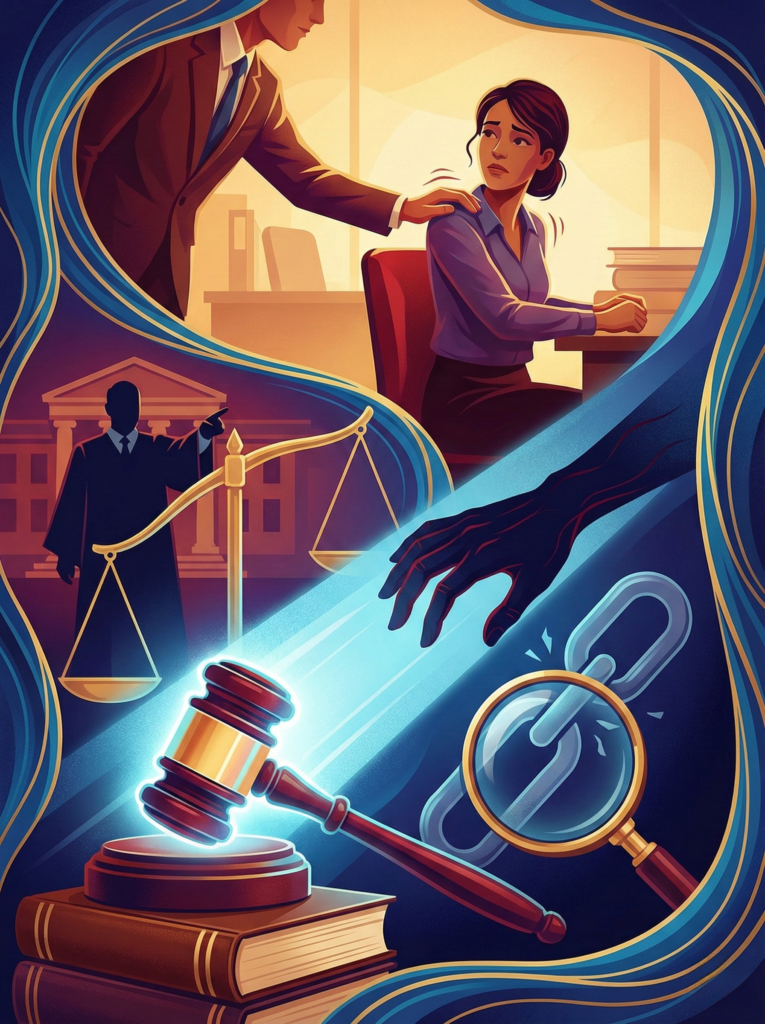
The Chairman argued that he never explicitly asked for sexual favors. The Supreme Court rejected this, ruling that the “demand, request, or requirement of a sexual favor” need not be explicit. The Court held that one can discern the demand from the offender’s acts. The sensation of his fingers on her neck and the squeezing of her shoulders were not “casual gestures of friendship” but acts that communicated sexual desire and an expectation of submission.
This ruling serves as a stark warning for “romantic” gestures. A manager who puts his arm around a subordinate during a Valentine’s party or “playfully” touches them cannot claim innocence simply because they did not verbally ask for sex. If the act creates an offensive environment, the law deems it harassment.

The Invitation Trap
The case of Villarama vs. National Labor Relations Commission (G.R. No. 106341) highlights the dangers of social invitations.
Here, a Materials Manager invited the female staff of his department to dinner. When other colleagues backed out, he proceeded to dine with a lone female clerk-typist. After dinner, he offered to drive her home but instead drove to a motel and attempted to kiss her. The employee resigned immediately, citing the “shocking experience” in her resignation letter. The company subsequently fired the manager for sexual harassment.
The Supreme Court upheld the manager’s dismissal, declaring: “Sexual harassment abounds in all sick societies. It is reprehensible enough but more so when inflicted by those with moral ascendancy over their victims”.
This case establishes that accepting a social invitation—like a Valentine’s dinner—does not constitute consent to sexual advances. The Court recognized the employee’s immediate resignation as constructive dismissal, treating her forced exit as an illegal termination by the employer due to the hostile environment created by the manager.
The Anti-Sexual Harassment Act of 1995 (RA 7877) focuses on offenders who have authority, influence, or moral ascendancy over the victim—such as bosses, teachers, or coaches.
- The Offense: It occurs when a superior demands or requests a sexual favor, regardless of whether the victim accepts or rejects it.
- The Context: It strictly applies to work, education, or training environments.
The Safe Spaces Act (RA 11313), or the “Bawal Bastos” law, significantly expanded liability. Unlike RA 7877, this law recognizes that harassment can occur between peers, subordinates to superiors, or even among strangers.
- “Unwelcome” Conduct: The law punishes unwanted sexual advances, sexist slurs, and comments that invade personal space.
- Online Harassment: It explicitly covers Gender-Based Online Sexual Harassment, which includes sending unwanted sexual remarks or “cyberstalking” via private messages.
- Myth 1: “It’s not harassment if I was just joking.” Fact: The law focuses on the effect on the victim, not the intent of the offender. Under the Safe Spaces Act, sexist remarks or “green jokes” that humiliate or offend the recipient are actionable, even if delivered with a smile.
- Myth 2: “She agreed to the date, so she led me on.” Fact: As seen in Villarama, agreeing to a meal is not a waiver of safety. Consent to dinner is not consent to intimacy. If a colleague says “no” to further advances, persisting constitutes harassment.
- Myth 3: “I can’t be fired for a personal message sent after work.” Fact: If the message impacts the work environment, you can be liable. Domingo vs. Rayala established the “three-fold liability rule”: a single act can lead to administrative dismissal, criminal imprisonment, and civil damages. Furthermore, online harassment under RA 11313 covers messages sent via social media.
Key Elements for Employer Liability
Employers bear a heavy burden. Under Article 297 (formerly 282) of the Labor Code, employers may terminate employees for “Serious Misconduct”. Sexual harassment qualifies as serious misconduct because it destroys the trust and safety essential to the workplace.
However, employers also face liability if they fail to act. The law mandates every workplace to create a Committee on Decorum and Investigation (CODI). Failure to constitute this committee is a violation of the law itself.
The desire for a warm, friendly workplace is natural in Filipino culture. However, Domingo and Villarama serve as stark reminders that “friendliness” must never come at the expense of dignity. Valentine’s Day serves as a stress test for your company’s culture. It reveals whether your “open door policy” translates to safe spaces or open season for harassment.
For employees, remember that you have the right to define your boundaries. For employers, your duty is active prevention. You cannot wait for a complaint to land on your desk; you must build the infrastructure that prevents harassment from occurring in the first place.

Leave a Reply