
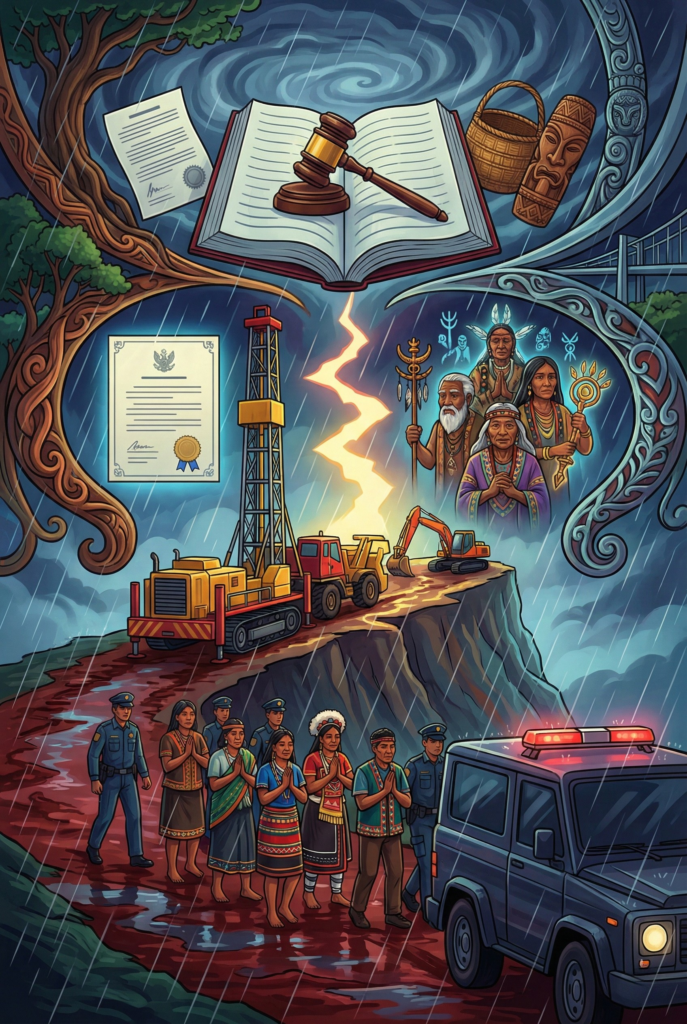
The rain in the Caraballo Mountains does not wash away the red mud; it only makes the barricade slicker. On January 23, 2026, in Dupax Del Norte, Nueva Vizcaya, the metallic click of handcuffs silenced the “Voice of the Mountain.” Authorities hauled seven residents—now known as the Dupax 7—into the back of a police truck after enforcing a court-ordered dispersal. Their only “crime” involved standing in the path of a drilling rig operated by Woggle Corporation, a subsidiary of the British firm Metals Exploration PLC. As the company moves its equipment onto the ridge, the legal battle lines sharpen. Woggle Corporation holds a state-sanctioned Exploration Permit, but the indigenous farmers hold something older—the memory of ancestors who never signed their land away.
As the company moves its equipment onto the ridge, the legal battle lines sharpen. Woggle Corporation holds a state-sanctioned Exploration Permit, but the indigenous farmers hold something older: the memory of ancestors who never signed their land away.

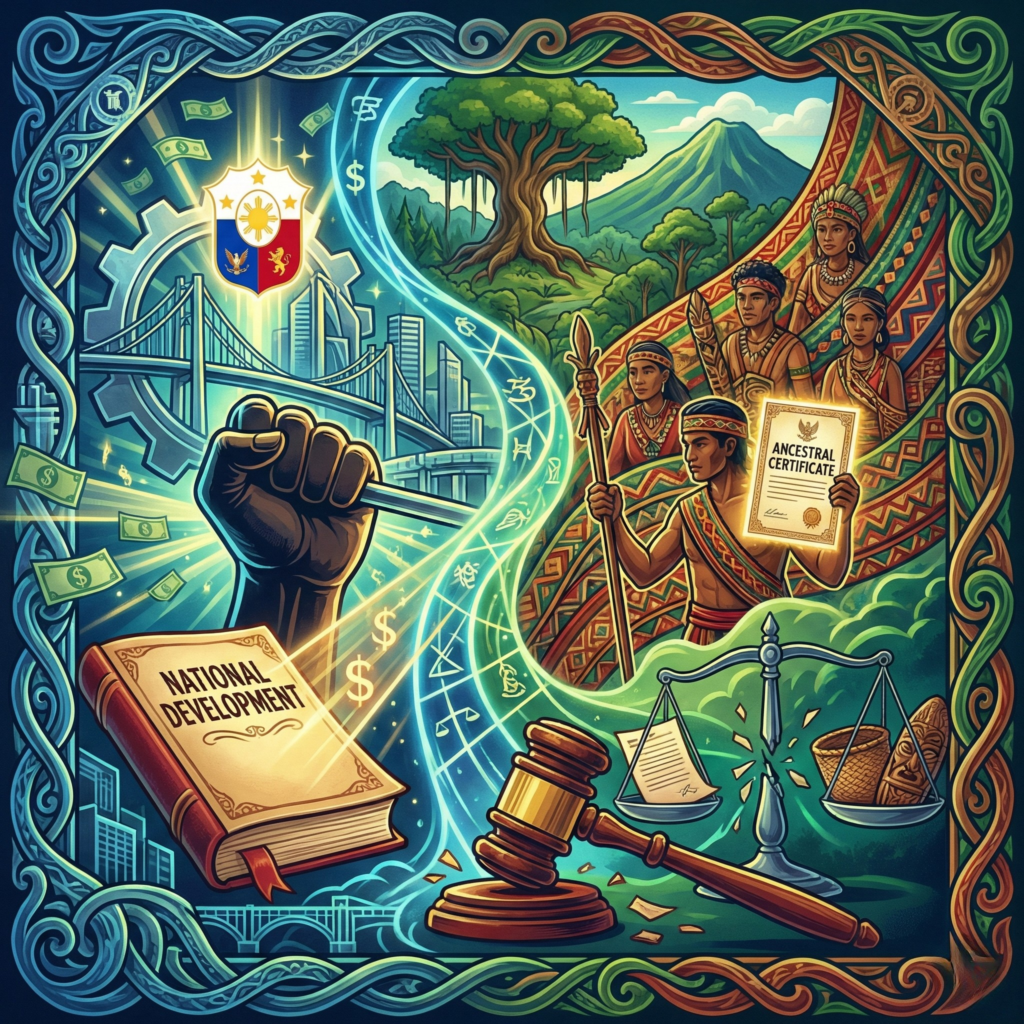
This scenario represents the quintessential Philippine legal struggle between national economic development and indigenous cultural integrity. The conflict centers on two competing legal pillars: the State’s power to manage natural resources and the indigenous peoples’ right to their ancestral domains.
The Foundation of State Power: The Regalian Doctrine

The Philippine legal system establishes the State’s primary authority over all natural resources through the Regalian Doctrine. This principle posits that the State owns all public lands and natural resources that do not fall under private ownership.
The 1987 Constitution: Article XII, Section 2 serves as the modern bedrock for this doctrine. It declares that the State owns all lands of the public domain, waters, minerals, coal, and petroleum.
State Control: The Constitution mandates that the State exercise “full control and supervision” over the exploration, development, and utilization of these resources to ensure they serve the collective interest of the Filipino people.
The Civil Code: Article 420 categorizes mineral lands as property of public dominion. Consequently, the State possesses the exclusive authority to grant mining rights to entities like Woggle Corporation.
Note: These permits do not transfer ownership of the land itself; instead, they grant a temporary right to explore or extract resources under strict government oversight.
The Turning Point: La Bugal-B’laan Tribal Association, Inc. v. Ramos
The case of La Bugal-B’laan Tribal Association, Inc. v. Ramos (G.R. No. 127882) remains the most influential ruling for the Philippine mining industry. This case tested the constitutionality of the Philippine Mining Act of 1995, specifically regarding 100% foreign-owned corporations and Financial and Technical Assistance Agreements (FTAA).
Initially, the Supreme Court declared several provisions of the Mining Act unconstitutional. The Court argued that the 1987 Constitution prohibited “service contracts” because such arrangements ceded the State’s “full control” to foreign entities.
However, the Court reversed its ruling in December 2004. It determined that “full control” does not require the government to perform every day-to-day task. Instead, the State maintains control by directing overall strategy and reserving the power to modify or set aside the contractor’s actions. This reversal effectively “opened the floodgates” for large-scale mining investments.
The Indigenous Shield: Native Title and the IPRA

While the State asserts rights over minerals, the Indigenous Peoples Rights Act (IPRA) of 1997 (Republic Act No. 8371) provides a powerful shield. The IPRA recognizes that indigenous cultural communities (ICCs) hold “Native Title” to their ancestral domains.
Indigenous Peoples Rights Act (IPRA) of 1997 (Republic Act No. 8371)
Time Immemorial: Native Title refers to land ownership held since “time immemorial”—as far back as memory goes.
Private communal ownership: The IPRA posits that indigenous communities held these lands in private, communal ownership long before the Spanish conquest or the establishment of the Republic.
Constitutional Validation: In Cruz v. Secretary of Environment and Natural Resources (G.R. No. 135385), the Supreme Court upheld the constitutionality of the IPRA. Justice Kapunan’s opinion affirmed that ancestral domains under Native Title represent a unique category of property that exists independently of the State’s land classification system.
Procedural Safeguards: Free, Prior and Informed Consent (FPIC)

The law balances state interests and indigenous rights through the Free, Prior and Informed Consent (FPIC) requirement. Section 59 of the IPRA prohibits government agencies from issuing any license for activities affecting an ancestral domain without a Certification Precondition from the National Commission on Indigenous Peoples (NCIP).
The NCIP issues this certification only after a field-based investigation confirms that the community gave its consent freely. The process follows five essential stages:
- Stage 1: Field-Based Investigation (FBI): NCIP teams identify if the project overlaps with an ancestral domain.
- Stage 2: First Community Assembly: NCIP explains the IPRA and the FPIC process to community leaders.
- Stage 3: Second Community Assembly: The mining company presents its operation plan, project risks, and environmental impacts.
- Stage 4: Consensus-Building: The community deliberates privately according to customary laws to grant or deny consent.
- Stage 5: Memorandum of Agreement (MOA): If the community approves, they sign a MOA outlining royalties (at least 1% of gross output) and social projects.
For the Dupax 7, the central legal question involves whether the corporation respected this process. If Woggle Corporation moved equipment onto the ridge without securing an FPIC Certification, their presence constitutes a legal violation.
Common Misconceptions About Mining and Ancestral Lands
Myth 1: A State permit always overrides local indigenous opposition.
Reality: While the State grants permits, the IPRA creates a “Certification Precondition.” Without this consent-based certification, a state permit overlapping an ancestral domain remains legally incomplete.
Myth 2: Indigenous groups can sell their ancestral land to the highest bidder.
Reality: The law renders ancestral domains inalienable. They belong to the community in perpetuity. While communities may grant rights of use via a lease or MOA, they always retain ownership of the soil.
Myth 3: Exploration permits are harmless because they do not involve extraction.
Reality: Indigenous communities view land as sacred. Even exploration disrupts traditional hunting grounds and spiritual sites. Consequently, the law requires the FPIC process even before the exploration stage begins.
The legal battle over the ridge in Nueva Vizcaya reflects a broader national imperative. The La Bugal decision ensures the State can attract capital for development, but the Cruz decision ensures that this development cannot steamroll indigenous communities.
The FPIC process remains the most critical tool for achieving this balance. When companies respect this process, they foster a “just partnership.” When they bypass it, they invite conflict and legal challenges.


Leave a Reply