
Introduction: The Filipino Marital Paradox
The Philippines stands almost alone in the world, alongside the Vatican City, as a nation without a general law on absolute divorce. For the average Filipino couple living in Manila or Cebu, the marital bond is permanent, dissolved only by death or the rigorous process of annulment.
However, millions of Filipinos live and love beyond the archipelago’s borders. In this globalized reality, mixed marriages between Filipinos and foreign nationals are common. When these cross-cultural unions fail, they often leave the Filipino spouse in a legal limbo: the foreign spouse secures a divorce abroad and moves on, while the Filipino remains legally married under Philippine law.
To remedy this inequality, Article 26, Paragraph 2 of the Family Code provides a lifeline. It allows the Filipino spouse to remarry if the foreign spouse has validly obtained a divorce abroad. While the law seems simple, its application has sparked intense legal debates, particularly regarding “mutual consent” divorces and administrative proceedings.
This guide explores how two landmark Supreme Court cases—Republic v. Ng (2024) 1 and Racho v. Tanaka (2018) 2—have revolutionized the judicial recognition of foreign divorce in the Philippines.
The Legal Doctrine: The “Correctional” Exception
Under the Nationality Principle (Article 15 of the Civil Code), laws relating to family rights and duties bind Filipino citizens wherever they are. Generally, a Filipino cannot escape their marriage simply by filing for divorce abroad.
However, recognizing the unfairness this creates in mixed marriages, the Family Code introduced an exception. Article 26, Paragraph 2 states that if a valid marriage between a Filipino and a foreigner results in a valid foreign divorce obtained by the alien spouse, the Filipino spouse shall also have the capacity to remarry.
The Supreme Court has consistently ruled that the intent of this law is to avoid the “absurd situation” where a Filipino remains married to a foreigner who is no longer married to them.
Landmark Case 1: Racho v. Tanaka (2018)
The Issue: Is a “Certificate of Acceptance” a Divorce Decree?
Rhodora Racho, a Filipino, married Seiichi Tanaka, a Japanese national, in Las Piñas City. Years later, Tanaka obtained a divorce in Japan by mutual agreement. Rhodora sought to have this divorce recognized in the Philippines so she could cancel her married name.
The Regional Trial Court (RTC) initially denied her petition. The judge argued that Rhodora failed to present a “judicial decree” because the divorce was consensual and administrative. She only had a “Certificate of Acceptance of the Report of Divorce” issued by the Mayor of Fukaya City.
The Supreme Court Ruling
The Supreme Court reversed the RTC’s decision, ruling in favor of Racho. The Court displayed a sophisticated understanding of Japanese law, noting that a divorce by agreement becomes effective upon notification and acceptance by the Family Registrar.
Consequently, the Court held that the Certificate of Acceptance is competent evidence. It proves that the divorce is valid and absolute under Japanese law. This ruling was pivotal because it instructed lower courts to look beyond the form of the document and focus on its legal effect under the foreign law.
Landmark Case 2: Republic v. Ng (2024)
The Issue: Is “Mutual Consent” Valid in the Philippines?
The recent case of Republic of the Philippines v. Ruby Cuevas Ng further clarified the validity of administrative divorces. Ruby Ng (Filipino) and Akihiro Sono (Japanese) obtained a divorce in Japan by “mutual agreement” without a court battle.
The Office of the Solicitor General (OSG) challenged the recognition of this divorce. They argued that because the divorce was not “adversarial” (there was no fight in court), recognizing it would violate Philippine public policy against “easy” divorces.
The Supreme Court Ruling
In a definitive decision promulgated on February 27, 2024, the Supreme Court rejected the OSG’s argument. The Court ruled that the form of the proceedings—whether judicial, administrative, or by mutual agreement—is irrelevant.
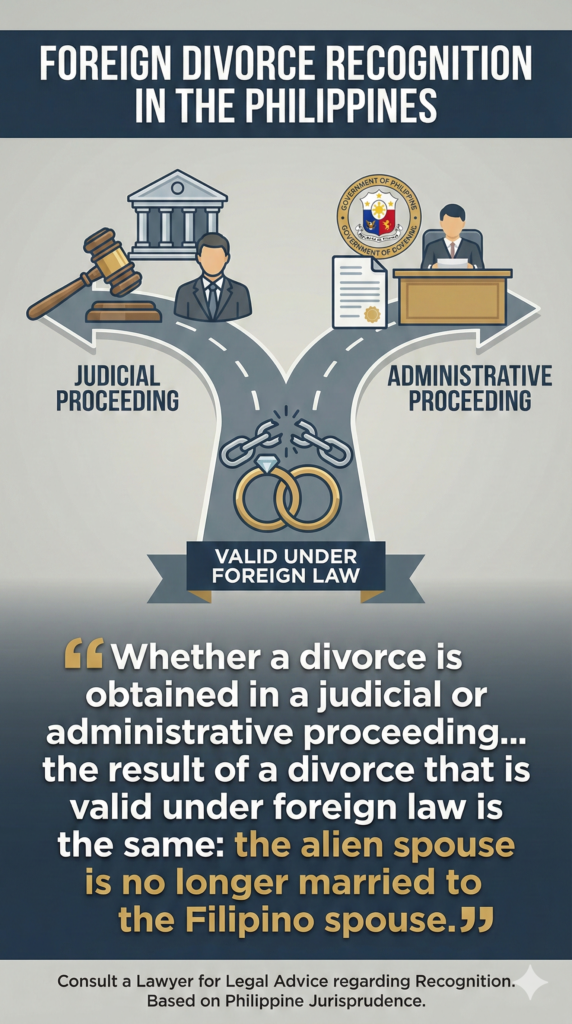
“Whether a divorce is obtained in a judicial or administrative proceeding… the result of a divorce that is valid under foreign law is the same: the alien spouse is no longer married to the Filipino spouse.”
This ruling confirms that Filipinos do not need to force their ex-spouses into a court trial abroad just to satisfy Philippine requirements. If the foreign country allows divorce by simple registration (like Japan’s kyogi rikon), the Philippines must respect it.
The Critical Warning: Proving Foreign Law
While Republic v. Ng was a victory for the validity of mutual consent divorce, it served as a stern warning regarding procedure.
Although the Supreme Court agreed with Ruby Ng in principle, it remanded her case back to the trial court. Why? Because she failed to strictly prove the law of Japan.
In the Philippines, courts do not take “judicial notice” of foreign laws. You cannot simply tell the judge, “Divorce is legal in Japan.” You must prove it as a fact using the Revised Rules on Evidence (Rule 132, Sections 24 and 25).
How to Prove Foreign Law:
- Official Publication: A government-published copy of the law.
- Attested Copy: A copy certified by the legal custodian of the record, authenticated by the Philippine Embassy or Consular Office (or Apostille).
Ruby Ng submitted copies of the law, but they lacked the proper certification. The Court emphasized that even if the divorce is real, the petition will fail (or be delayed) if the foreign law is not proven according to strict evidentiary rules.
Key Requisites for Recognition
To successfully file a Petition for Judicial Recognition of Foreign Divorce, you must establish the following elements in court:
- Valid Marriage: Proof of the marriage celebrated between a Filipino and a foreigner (PSA Marriage Certificate).
- Fact of Divorce: The authentic foreign divorce decree (e.g., Rikon Juri Shomeisho for Japan, Court Judgment for USA) with an Apostille.
- Capacity of the Alien Spouse: Proof that under the foreign spouse’s national law, the divorce is valid and allows them to remarry.
- Proof of Foreign Law: An authenticated copy of the relevant foreign divorce law, often supported by an expert witness.
Common Misconceptions
Myth 1: “I am automatically single once divorced abroad.” Fact: No. The divorce is a fact abroad, but it is not yet a fact in the Philippines. You remain married in Philippine records (PSA) until a Philippine Court issues a decision recognizing the foreign decree.
Myth 2: “Mutual consent divorces are void here.” Fact: False. As established in Republic v. Ng and Racho v. Tanaka , the Philippines recognizes divorces obtained by mutual agreement, provided they are valid in the foreign country.
Myth 3: “I need my ex-spouse’s cooperation.” Fact: While helpful, it is not strictly required. You need the documents (Divorce Decree and Foreign Law). If you can obtain these from the foreign registry or public archives, you can proceed even without the active participation of the alien spouse.
Conclusion
The Supreme Court’s rulings in Republic v. Ng and Racho v. Tanaka have significantly liberalized the recognition of foreign divorces in the Philippines. By accepting administrative and mutual consent divorces, the Court has prioritized the “correctional” intent of the law over rigid procedural technicalities.
However, the process remains a judicial one. It requires a lawyer, a petition in court, and strict adherence to the Rules on Evidence. As Ruby Ng’s case demonstrates, having a valid divorce is not enough—you must prove it with the precision required by Philippine law.
For Filipinos trapped in the legal aftermath of a mixed marriage, these rulings offer a clear path to freedom: a path that honors the reality that when a marriage ends abroad, it should, in the eyes of justice, end at home as well.

Leave a Reply