

Introduction: The Race Against Time
In the Philippine judicial system, time often acts as the greatest adversary. The parties file a complaint, and years pass before they receive a final judgment. During this gap, the parties can alter the situation: they might fence off a disputed piece of land, sell a corporate asset, or demolish a structure. If the parties change the status quo before the court decides, they can make the final victory hollow—a “pyrrhic victory” where they have already lost the prize.
This is where the Writ of Preliminary Injunction comes into play. Known as the “Strong Arm of Equity,” it acts as a provisional remedy governed by Rule 58 of the Rules of Court. It aims to “pause” a dispute, preserving the status quo until the main case reaches resolution.
The Legal Doctrine
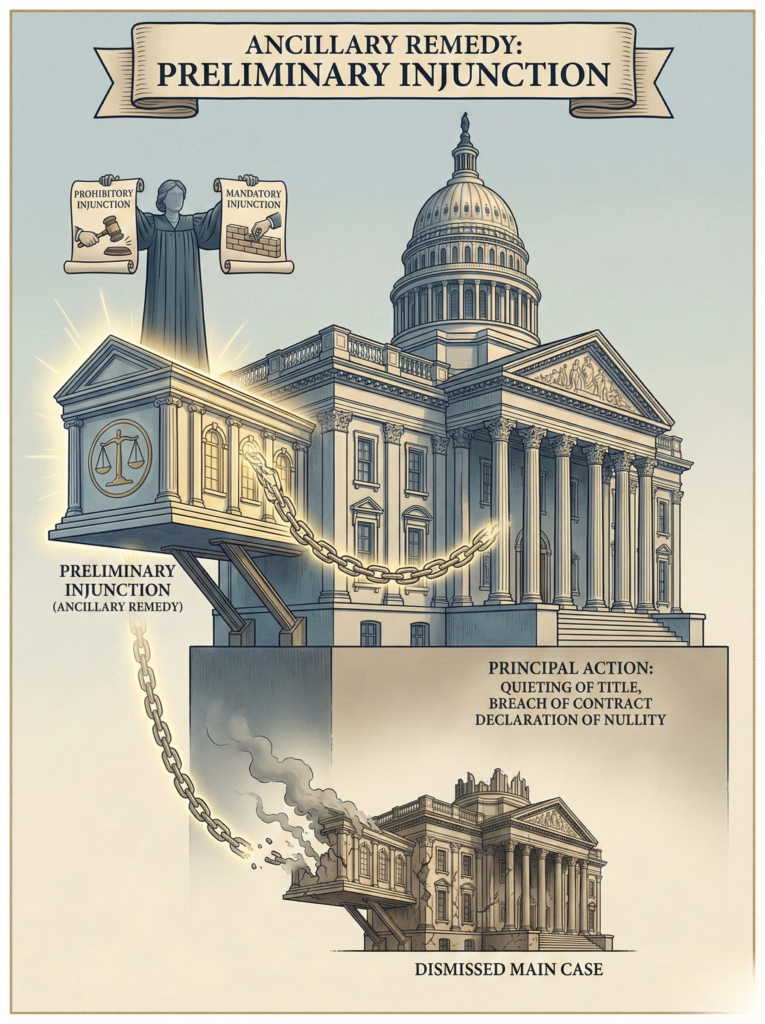
A court grants a preliminary injunction at any stage of an action before the final judgment. It commands a party to either refrain from a specific act (Prohibitory Injunction) or perform a specific act (Preliminary Mandatory Injunction).
It is crucial to understand that this serves as an ancillary remedy. You cannot file a standalone case just to ask for an injunction; you must attach it to a principal action, such as a case for Quieting of Title, Breach of Contract, or Declaration of Nullity. If the court dismisses the main case, it automatically dissolves the injunction.
Authority and Jurisdiction
The court where the action is pending holds the power to issue this writ—usually the Regional Trial Court (RTC), although the Court of Appeals (CA) and Supreme Court (SC) also possess this power. The law is strict: generally, the court cannot grant a preliminary injunction without holding a hearing and giving prior notice to the other party.
The Four Essential Requisites
An injunction restricts a person’s rights before a trial is complete, so the Supreme Court demands high standards of proof. Recent cases like City Government of Caloocan v. Carmel Development (2023) and Now Telecom v. NTC (2024) outline the four key elements the applicant must prove to obtain an injunction:
A Clear and Unmistakable Right: The applicant must show that the right to be protected is real and existing, not based on future hopes. For instance, a Torrens Title demonstrates a clear right to land, whereas an application for a title that hasn’t been approved cannot establish a clear right.
Material and Substantial Invasion: There must be a genuine violation or threat to the right. A minor inconvenience does not qualify; the act must affect the essence of the right in a meaningful way. For example, a threat to a person’s property rights that could lead to substantial loss qualifies for an injunction.
Urgent Need to Prevent Irreparable Injury: This is the most critical requirement. Irreparable injury refers to harm that cannot be measured by money or restored. If the damage involves lost profits, the appropriate remedy is a lawsuit for damages, not an injunction. Injuries such as the destruction of a historical property or the disclosure of confidential information can be considered irreparable.
No Other Speedy Remedy: The court will grant an injunction only if no other remedy can address the damage in time. If other remedies, such as damages or alternative legal actions, are available and faster, the court may deny the injunction.
The Temporary Restraining Order (TRO) vs. Injunction
A common source of confusion is the difference between a Temporary Restraining Order (TRO) and a Preliminary Injunction. They are not the same.
The TRO (The Emergency Stop): If the matter is of extreme urgency, the court may issue a TRO. If issued by an Executive Judge, it is good for 72 hours. It can be extended by the presiding judge after a summary hearing, but in no case can it exceed 20 days.
- Automatic Expiration: Under B.P. Blg. 224, a TRO expires automatically on the 20th day. If the court does not issue a preliminary injunction by then, the restraint is lifted. There is no need for a court order to declare it dead; it dies by operation of law.
- The Preliminary Injunction (The Long Pause): Unlike the TRO, this writ has no expiration date. It remains effective until the final judgment of the case or until the court dissolves it. However, it requires a mandatory hearing and the posting of a bond to answer for damages if the court later finds the applicant was not entitled to it.
Real-World Applications
1. Real Estate and Untitled Lots
In the Philippines, many families live on “untitled lots” holding only tax declarations. If a developer tries to fence off their property, can they get an injunction? Yes, but it is difficult. Since they lack a Torrens Title, they must prove a “clear legal right” through other means. As highlighted in cases regarding the Registration of Untitled Lots, the applicant must present evidence of “open, continuous, exclusive, and notorious possession” (Section 14(1) of PD 1529). Without strong proof of possession, the court will likely deny the injunction, prioritizing the Torrens Title holder.
2. Lost Titles and Fraud
If a landowner loses their Owner’s Duplicate Title, they are vulnerable to fraud. During the Petition for Reconstitution proceedings, if a third party tries to register a sale using the lost title, the owner must seek an injunction. The “Electronic Copy of the Title” from the Registry of Deeds serves as the evidence of the clear right needed to stop the Register of Deeds from processing the fraudulent transfer.
3. Corporate Disputes: The One Person Corporation (OPC)
The One Person Corporation (OPC) is a legitimate business structure under the Revised Corporation Code. A common issue arises when creditors of the individual stockholder try to seize the assets of the OPC. Using the doctrine of corporate fiction, the OPC can seek an injunction. It must argue that the corporation has a personality separate from the individual. Seizing the OPC’s assets (like delivery trucks) for the stockholder’s personal debt would cause irreparable injury to the business operations. The “clear right” here is the OPC’s distinct juridical personality.
Common Misconceptions
Myth 1: “Getting an injunction means I won the case.”
Fact: No. The court grants an injunction provisionally. It only preserves the status quo. You still need to go through the full trial to prove your ownership or right. If you lose the trial, the court lifts the injunction, and you may become liable for damages against the bond.
Myth 2: “I can get a secret injunction (ex-parte).”
Fact: Except for the 72-hour TRO, the court rarely grants “ex-parte” injunctions. Due process requires that the court notify the other party and give them a chance to be heard before it issues a writ.
Myth 3: “Losing money is irreparable injury.”
Fact: Courts generally rule that if the loss is calculable (e.g., PHP 500,000 in lost sales), it is reparable. The court can compensate you later. Irreparable injury typically refers to non-monetary loss, such as damage to reputation, goodwill, or unique property.
Rule 58 is a powerful tool, but it is not a magic wand. It requires a delicate balance between the urgency of the applicant’s need and the due process rights of the respondent. Whether you are protecting a family home, a business asset, or a contractual right, the success of an injunction application hinges on evidence—specifically, proof of a “clear right” and “irreparable injury.”
For any legal strategy, remember the golden rule of provisional remedies: They are temporary. The ultimate goal is winning the main case.
Please remember that this post is intended for general informational purposes only and does not, in any way, constitute legal advice. Every situation is unique, and you should always consult a qualified lawyer for professional advice regarding your specific concerns. The scenarios and examples provided in this article are purely fictional and for illustrative purposes only and are not based on any actual case or controversy.

Leave a Reply