
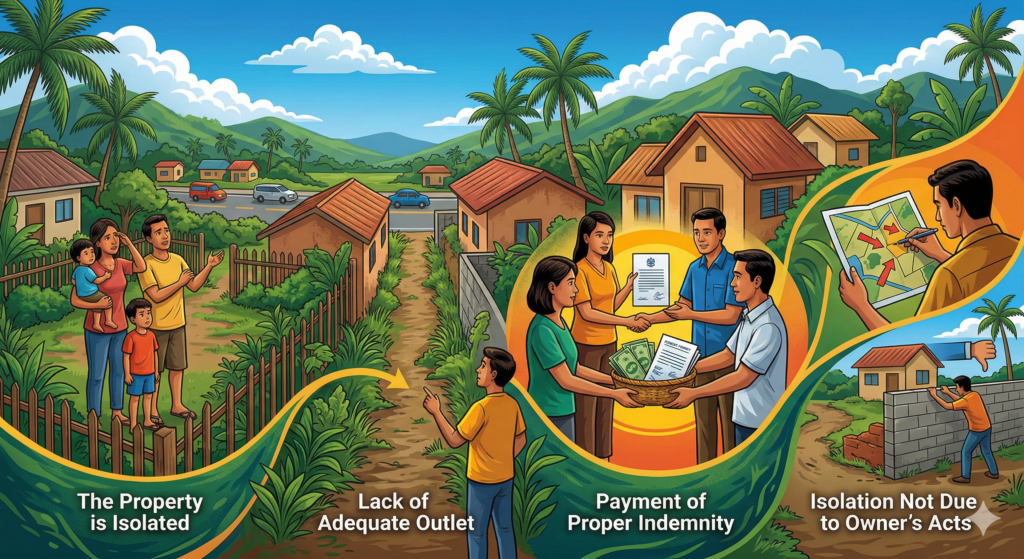
Imagine buying your dream lot or inheriting a piece of ancestral land, only to realize that you have no direct access to a public road. You find yourself surrounded by neighbors’ fences, and every time you leave your house, you feel like you are trespassing. This scenario is a common reality for many Filipino property owners, often leading to heated disputes and neighborhood tensions.
In the Philippines, the law does not intend for any piece of land to become useless due to isolation. The legal system provides a solution called a Compulsory Right of Way. This legal easement ensures that a landlocked owner can access a public highway, provided they meet specific legal requirements. Understanding these rules is essential for maintaining both your property’s value and your peace of mind.
The Legal Doctrine of Right of Way
The concept of a compulsory right of way finds its roots in the Civil Code of the Philippines. Specifically, Article 649 provides that an owner of an immovable property surrounded by others without an adequate outlet to a public highway may demand a right of way through neighboring estates.
However, this right is not absolute or automatic. The Supreme Court has consistently emphasized that the claimant must pay the proper indemnity to the neighbor whose land will be used. Furthermore, the law clarifies that this easement is not compulsory if the owner’s own actions caused the isolation.
In the case of Spouses Williams v. Zerda (G.R. No. 207146, 2017), the Supreme Court reiterated that the right of way is a “legal” easement. This means the law itself creates the burden on the neighbor’s property for the benefit of the isolated land. Similarly, in Spouses Vargas v. Sta. Lucia Realty and Development, Inc. (G.R. No. 191997, 2022), the Court highlighted that the person requesting the path must strictly prove that all legal requisites exist before a court grants the easement.
The 4 Essential Requisites for a Compulsory Right of Way
To successfully claim a compulsory right of way, a property owner must establish four specific conditions. Failure to prove even one of these can lead to the dismissal of a legal claim.
- The Property is Isolated: The “dominant estate” (the land needing the path) must be surrounded by other properties belonging to different persons.
- Lack of Adequate Outlet: There must be no adequate outlet to a public highway. If an existing path is simply inconvenient but functional, the court might not grant a new right of way.
- Payment of Proper Indemnity: The owner of the landlocked property must pay the neighbor (the “servient estate”) for the use of the land and any damages caused.
- Isolation is Not Due to the Owner’s Own Acts: If you sold a portion of your land that previously gave you road access, or if you built a wall that blocked your own exit, you cannot demand a compulsory easement from your neighbors.
Location and Width: Finding the Balance
According to Article 650 of the Civil Code, the right of way must be established at the point least prejudicial to the neighbor. If there are two possible paths, the law prefers the one that causes the least damage. Simultaneously, the path should follow the shortest distance to the public highway.
As for the width, Article 651 explains that the distance should be sufficient to meet the needs of the dominant estate. This means a path intended for a family home might only need to be wide enough for a car, whereas a commercial farm might require a wider road for trucks.
Common Misconceptions About Right of Way

Despite the clear provisions of the Civil Code, several myths persist among Filipino landowners.
Myth 1: Access is always free because it is a “Right.”
Many people believe that if they are landlocked, their neighbor must give them a path for free. This is incorrect. The law explicitly requires the payment of indemnity. You are essentially “renting” or “compensating” for the loss of use of your neighbor’s land. If the path is permanent, the indemnity usually consists of the value of the land occupied plus the amount of damage caused to the neighbor’s property.
Myth 2: I can choose the most convenient path for myself.
While you might prefer a path that offers a better view or a smoother incline, the law prioritizes the neighbor’s convenience. The “least prejudicial” rule means you might have to accept a longer or less ideal route if it saves your neighbor from having to tear down an existing structure or disrupt their private space.
Conclusion
Navigating property boundaries in the Philippines requires a delicate balance between exercising your rights as an owner and respecting the rights of your neighbors. A compulsory right of way is a powerful tool to ensure your property remains accessible and productive, but it is a remedy of necessity, not convenience.
By understanding the four requisites—isolation, lack of outlet, indemnity, and lack of self-inflicted isolation—you can approach road access issues with a clear legal perspective. Whether you are the one seeking a path or the neighbor asked to provide one, knowing the Supreme Court’s stance helps in reaching a fair and legal resolution.
For more insights on Philippine property laws and civil rights, visit our articles archive.
If you are currently facing a dispute regarding property access or need assistance in negotiating an easement, it is best to consult with a legal professional to ensure your interests are protected.


Leave a Reply