

The modern world moves at a speed that often exceeds the human capacity to process it. Imagine a typical morning in a bustling city like Manila. A professional wakes up to the sharp chime of a smartphone. Before even leaving bed, this individual scrolls through twenty TikTok videos, scans fifteen Facebook updates, and glances at a dozen work emails.
This rapid-fire consumption of information happens within minutes. Later, while sitting in a boardroom for a strategic planning session or attending a university lecture, that same individual finds it nearly impossible to focus on a single speaker for more than ten minutes. The mind wanders, searching for the next digital “hit” of information. This experience is not a sign of a broken brain; rather, it reflects a phenomenon that researchers now call “Popcorn Brain.”
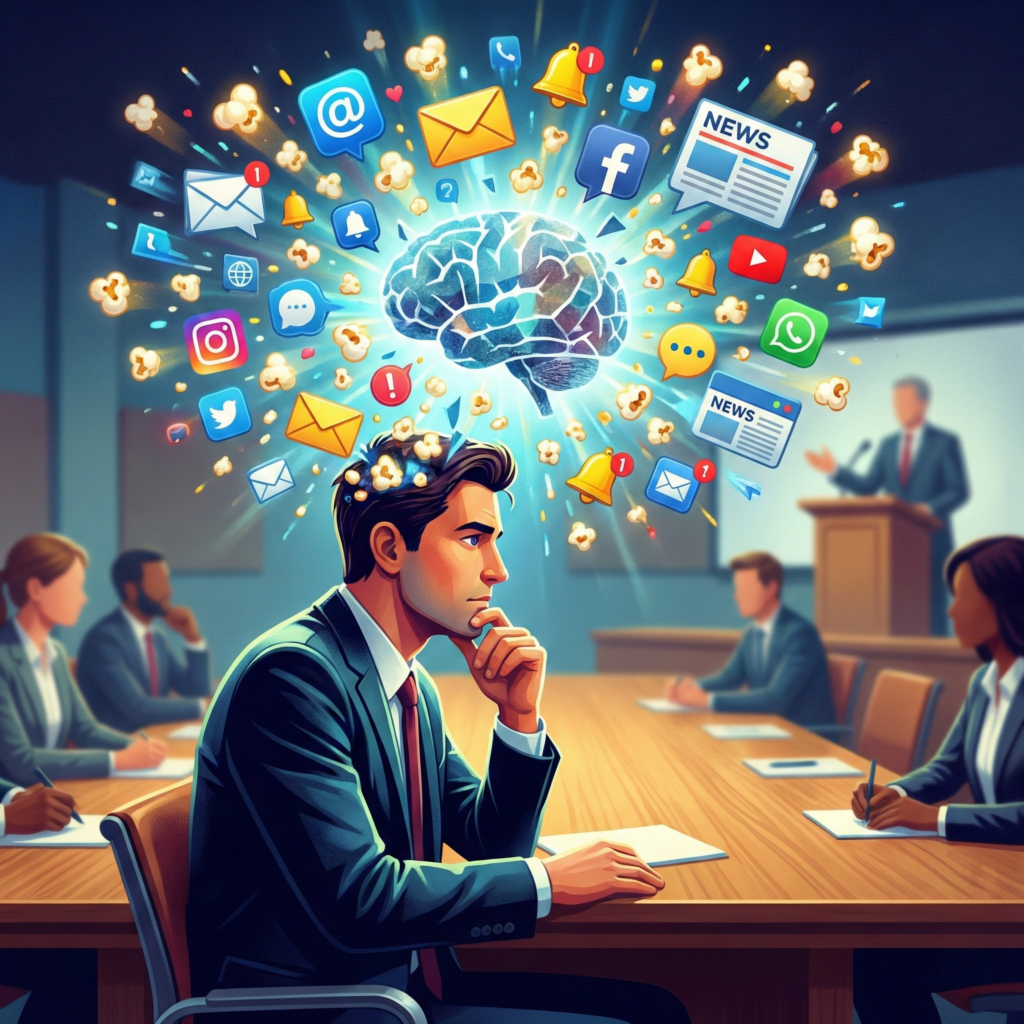
Researcher David Levy coined the term “Popcorn Brain” to describe a mental state so accustomed to the fast-paced, multi-tasking environment of the internet that it struggles to adapt to the significantly slower pace of real life. This condition increasingly affects the productivity of the Filipino workforce and the academic performance of students. As the digital landscape in the Philippines continues to expand, understanding the intersection between this neurological shift and Philippine law becomes essential for employers, educators, and the general public.
The Science of Popcorn Brain: Understanding Neuroplasticity
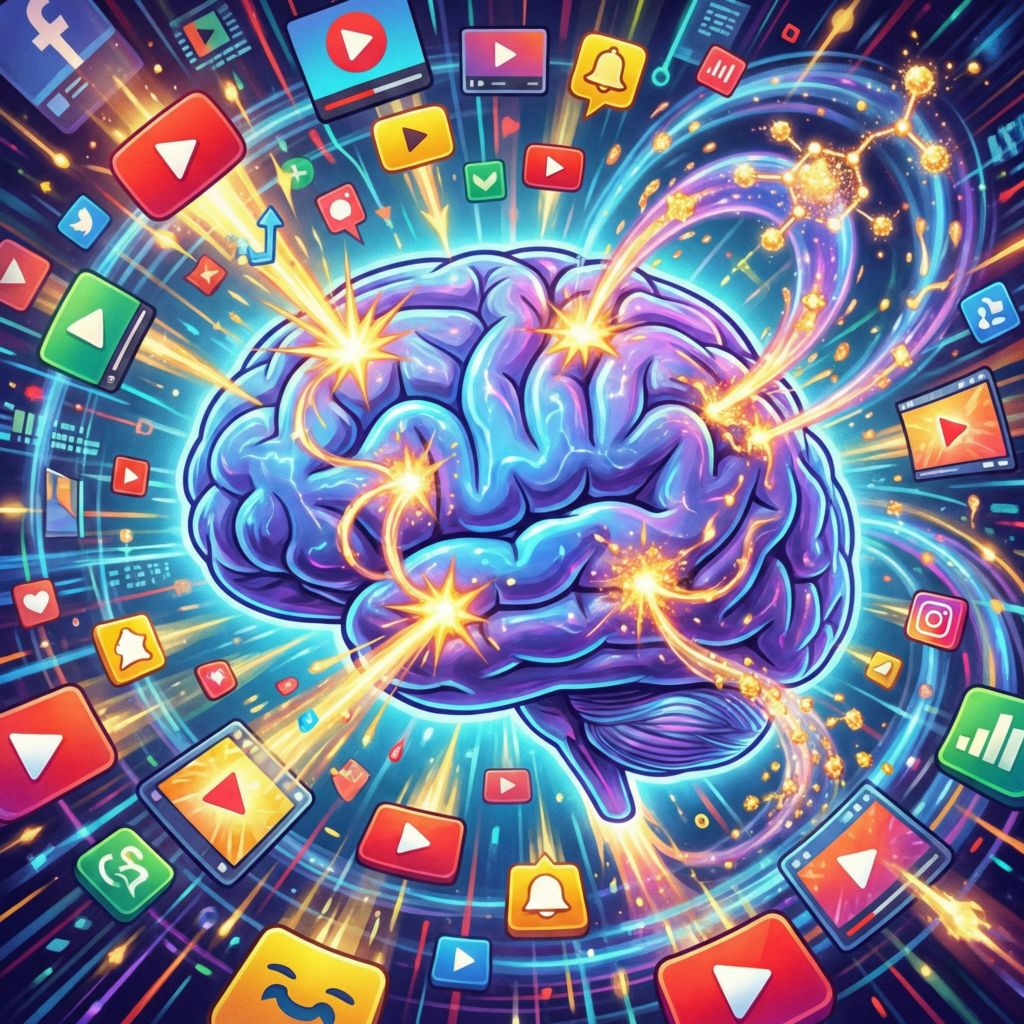
One must first understand that the brain is not a static organ. It possesses neuroplasticity, which refers to the ability of neural pathways to reorganize themselves based on new experiences. When individuals consume short-form media—such as 15-to-60-second video clips—they are effectively training their brains to expect a reward in the form of dopamine at incredibly high frequencies.
Dopamine functions as a neurotransmitter that signals reward and pleasure. In the digital environment, every notification, like, or catchy video hook triggers a small dopamine release. When the brain receives these hits every minute, it becomes conditioned to that specific delivery frequency.
Consequently, when a person attempts to engage in a “sustained attention task,” such as reading a complex legal document or participating in a sixty-minute meeting, the brain perceives these activities as “boring”. The dopamine delivery frequency has dropped, and the “trained” brain begins to experience a form of stimulation withdrawal.
| Component of Popcorn Brain | Neurological Mechanism | Real-World Impact |
| Short-Form Media | Neural training via 15-60 second cycles | Decreased patience for long-form content |
| Dopamine Hits | High-frequency reward delivery | “Boredom” during low-stimulation tasks |
| Neuroplasticity | Pathway reorganization | Habitual multi-tasking and fragmented focus |
The Global Shift in Media and Education
The phenomenon of Popcorn Brain is not merely a subjective feeling; it is a measurable trend that has forced major industries to alter how they deliver content. From music to education and film, the “TikTok-ification” of information is a response to the shrinking human attention span.
The Evolution of the Music Industry
The music industry provides one of the clearest examples of this shift. In the 1990s, the average hit song often exceeded four minutes. Today, artists and producers create shorter songs to maximize “stream counts” and fit within the constraints of social media trends [Case 1]. Data from the Billboard Hot 100 shows that the average length of a song decreased by 20 seconds between 2013 and 2018 [Case 1].
Research suggests that student engagement drops significantly after just 10 to 15 minutes of traditional lecturing [Case 2]. By using interactive transitions to “reset” the attention clock, educators attempt to accommodate the neuroplastic changes in the modern student’s brain.
Faster Cutting Rates in Film and TV
Even the film industry has adjusted its editing styles. Hollywood movies now feature significantly faster “cutting rates,” which refers to the speed at which a camera shot changes [Case 3]. In 1930, the average shot length in a film was roughly 12 seconds. Today, that average has dropped to approximately 2.5 to 4 seconds [Case 3]. These rapid visual changes keep the viewer’s eye stimulated, preventing the “boredom” that might lead them to look at their phones during a movie.
| Industry | Metric of Change | Shift in Strategy |
| Music | Average length decreased by 20 seconds [Case 1] | Skip intros; move to “hook” in 5-10s [Case 1] |
| Education | Engagement drops after 10-15 minutes [Case 2] | Use 10-minute “chunks” (Micro-learning) [Case 2] |
| Film/TV | Average shot length: 12s (1930) to 2.5-4s (Today) [Case 3] | Increase “cutting rates” for stimulation [Case 3] |
The Philippine Legal Landscape: The Mental Health Act
While “Popcorn Brain” is a relatively new term, the psychological stress and potential mental health conditions resulting from digital over-stimulation fall under the protective framework of Philippine law. The primary statute governing this area is the Mental Health Act, or Republic Act No. 11036.
The Rights of the Individual
The Mental Health Act affirms the basic right of all Filipinos to mental health and the rights of people who require mental health services. The state commits to ensuring that mental health is valued, promoted, and protected. Under the law, a “Mental Health Condition” refers to a neurologic or psychiatric condition characterized by a clinically significant disturbance in an individual’s cognition, emotional regulation, or behavior.
If the cognitive fragmentation associated with Popcorn Brain reaches a level that significantly disturbs an individual’s ability to function or cope with normal life stresses, it may qualify for protection and support under this Act. The law guarantees every person the right to live and work free from stigma and discrimination related to their mental health status.
Mental Health in the Workplace
The Department of Labor and Employment (DOLE) issued Department Order No. 208, Series of 2020 (DO-208), which provides guidelines for implementing mental health policies in the private sector. This order makes it mandatory for all workplaces to develop a Mental Health Workplace Policy and Program.
The objectives of DO-208 include:
Raising awareness and preventing stigma and discrimination against workers with or at risk of mental health conditions.
Promoting the well-being of workers toward healthy and productive lives.
Providing support and facilitating access to health care services for workers needing treatment.
Employers must not deprive workers of employment, promotion, or benefits because of their mental health conditions, provided these conditions do not interfere with job performance or safety.
The Legal Doctrine: Abuse of Rights and Human Relations
In the Philippines, the law does not only regulate physical actions; it also governs human conduct and the manner in which rights are exercised. This is known as the “Abuse of Rights” principle, found in Article 19 of the Civil Code.
Article 19 provides: “Every person must, in the exercise of his rights and in the performance of his duties, act with justice, give everyone his due, and observe honesty and good faith”.
This principle sets a primordial limitation on all rights. Even if an action is technically legal, it can become a source of liability if it violates the standards of justice and good faith. In the context of the digital workplace, an employer who uses technology to constantly monitor or overwhelm an employee beyond reasonable hours might be violating these standards.
As established in the case of GF Equity v. Valenzona, the law recognizes that the exercise of a right ends when it is abused to the prejudice of others. If a manager’s “right to manage” is exercised in a way that causes mental anguish or severe stress, the employee may have a cause of action for damages under Article 20 or 21 of the Civil Code.
| Civil Code Provision | Standard of Conduct | Legal Implication |
| Article 19 | Act with justice, honesty, and good faith | The “Abuse of Rights” principle |
| Article 20 | Willful or negligent acts contrary to law | Liability for resulting damages |
| Article 21 | Acts contrary to morals or good customs | Compensation for damage caused willfully |
The Proposed “Right to Disconnect”
One of the most direct legal responses to the problem of Popcorn Brain and digital burnout is House Bill No. 9735, currently pending in the Philippine Congress. This bill proposes the “Right to Disconnect,” which would grant employees the right to disengage from work-related electronic communications after work hours.
The explanatory note of the bill highlights that the constant expectation to answer emails and messages outside of regular hours adds significant stress and destroys work-life balance. It specifically mentions “anticipatory stress”—the feeling of being constantly on call—which leads to burnout and psychological distress. By establishing boundaries around digital communication, the bill aims to give the brain the rest it needs to recover from high-stimulation digital environments.
Key Elements for a Healthy Workplace
Employers and employees must collaborate to create a workspace that respects psychological well-being. Under the Mental Health Act and DOLE guidelines, the following requisites are essential for a valid mental health program:
Awareness and Education:
All workers must receive basic information on mental health and the impact of stressors in the workplace.
Confidentiality:
Employers must keep all medical and psychiatric information strictly confidential.
Work Accommodation:
Management and workers should agree on arrangements for those needing treatment, such as flexible schedules, provided the worker remains fit for duty.
Non-Discrimination:
No form of distinction or exclusion should nullify the rights of a person with a mental health condition.
Access to Support:
Programs must include referral systems to DOH-licensed mental health facilities.
Common Misconceptions
Myth 1: You must have a documented history of mental illness to seek help.
The Supreme Court has clarified that a documented history is not a prerequisite for claiming a mental health condition as a defense or a basis for support. In the case of People v. S. (2025), the Court emphasized that requiring prior medical records would unfairly disadvantage those who lack access to psychiatric care due to poverty. Mental health support should be accessible to all, regardless of previous medical history.
Myth 2: Mental health is purely a personal issue and doesn’t involve the employer.
The law says otherwise. The Mental Health Act (RA 11036) and DOLE DO 208-20 place a legal duty on employers to protect the psychological well-being of their workforce. Workplace mental health is both a part of labor compliance and responsible leadership.


Leave a Reply