
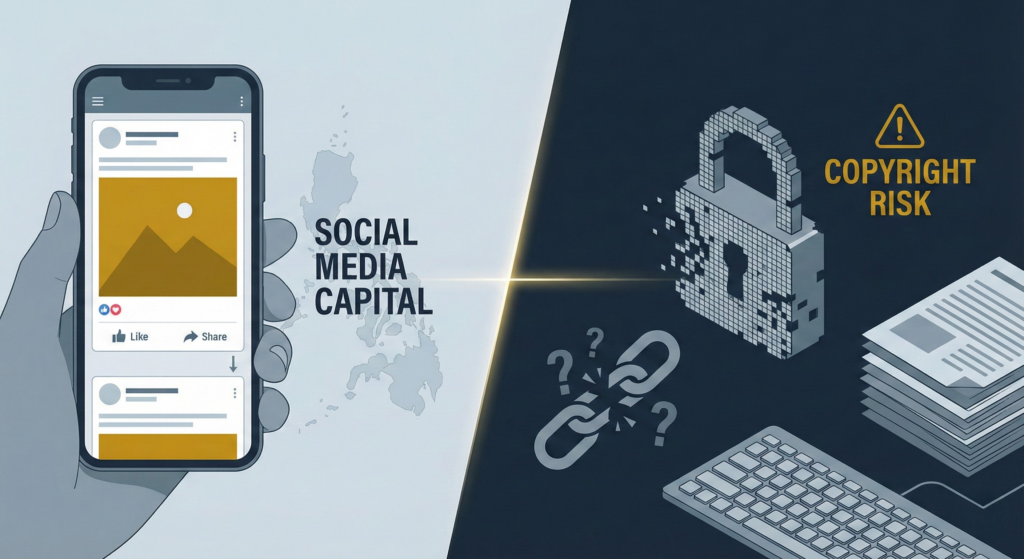
In the Philippines, the title of “Social Media Capital of the World” is held, where scrolling, liking, and sharing are considered second nature. But amidst all this digital excitement, there’s a dangerous misconception: that the internet is some kind of “public domain,” a free-for-all where anyone can take and share whatever they want.
But here’s the hard truth: what you’re posting online could actually land you in serious legal trouble. You might be committing copyright infringement without even realizing it.
An Aspiring Content Creator’s Digital Dilemma
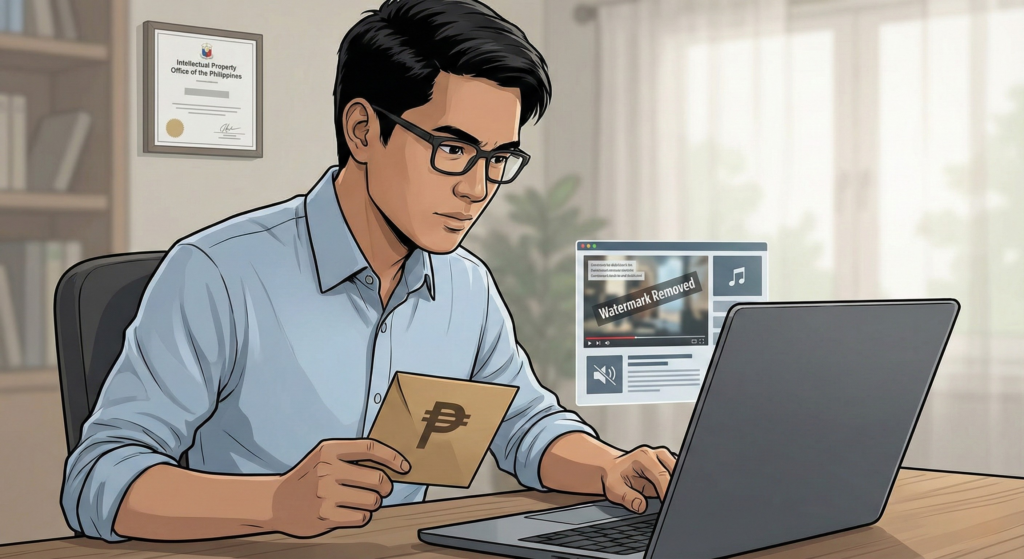
Let’s say someone creates a page dedicated to “Pinoy Humor.” They want to grow their audience quickly, so they download viral clips from TikTok, crop out the original watermarks, add their own commentary, and upload them to Facebook. For an added boost, they use popular Top 40 songs as background music to attract more views. The page gains traction, and a local business even offers payment to feature their logo in the next video.
What might seem like a savvy digital marketing move is, in fact, a legal minefield. By re-uploading those videos, using copyrighted music, and profiting from someone else’s work, this content creator has most likely violated copyright laws under the Philippines’ Intellectual Property Code.
This article explores the hard truths about digital ownership, guided by the Intellectual Property Code and recent Supreme Court rulings like Cosac, Inc. v. FILSCAP and ABS-CBN v. Andalampatuan
The Legal Reality: Content Is Property, Not Free-for-All Material
Here’s a myth that needs busting: “You need to register your work to own the copyright.” This isn’t true. Republic Act No. 8293, the Intellectual Property Code of the Philippines (IPC), automatically grants copyright protection the moment you create a work. No paperwork is needed. When you post a selfie, write a caption, or upload a video, you automatically own the copyright.
The Supreme Court solidified this in its 2023 ruling in Cosac, Inc. v. FILSCAP, confirming that using copyrighted material without permission is infringement. So, when you use a song in your vlog or upload a video without permission—especially if you’re making money off it—you’re crossing legal boundaries.
“Share” vs. “Steal”: The Fine Line
Now, you might be wondering, “Does hitting ‘share’ on Facebook make me a criminal?” Generally, no. But there’s a difference between sharing and stealing. When you hit the “Share” button, you’re typically linking to the original post without creating a new copy. That’s usually safe.
But if you download a video, crop the watermarks, and re-upload it as your own? That is considered “freebooting,” and it is deemed illegal. You’ve violated the owner’s right to reproduce and distribute their work.
Key Elements of Copyright Infringement: Are You at Risk?
Copyright infringement doesn’t only affect content creators. A brand manager can face liability if they benefit from another person’s illegal post, such as when they ignore an influencer using stolen music in their content. They also face accountability if they contribute to or enable someone else’s infringement.
• Myth 1: “It’s fine if I put ‘CTTO’ (Credits to the Owner).”
Fact: Giving credit doesn’t protect you from infringement. If you’re monetizing stolen content, you’re still in violation.
• Myth 2: “I can use 30 seconds of a song or movie.”
Fact: There’s no “30-second rule” in the Philippines. Even short clips can infringe copyright if they capture the essence of the original work.
• Myth 3: “I’m just a small account, so it doesn’t matter.”
Fact: It doesn’t matter how small your account is. Copyright laws apply to everyone, and digital platforms use AI to identify and remove infringing content instantly.
What’s at Stake? Your Reputation and Your Business
Violating copyright has serious consequences. You could face hefty fines or lawsuits, and you could also permanently damage your online reputation. Whether you’re an influencer, a business, or just an avid social media user, your actions online have real-world legal consequences.
And it’s not just about copyright. Harassment, privacy violations, and cyberstalking are also illegal in the digital space. What you post online could violate multiple laws if you’re not careful.
Protect Yourself: The Digital World Isn’t a Wild West
The internet may feel like an open space, but it is governed by laws that protect the rights of creators.. Don’t assume that just because it’s online, it’s free for the taking.
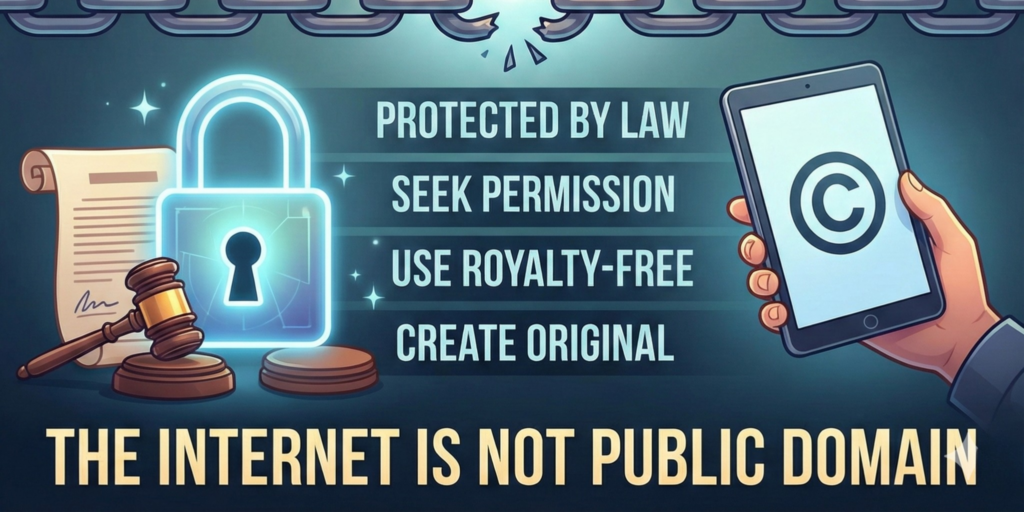
If you’re sharing or re-uploading content, be sure to seek permission, use royalty-free materials, or create original work. Avoid the shortcut that is stealing other people’s creations.
Click Here to Explore the Fundamental Concepts of Intellectual Property
YouTube Link: https://www.youtube.com/watch?v=I0onf2CKyzA
YouTube Channel: Kopiraittila
Key Takeaway:
You might think you’re just having fun with social media, but the truth is that you’re putting yourself at risk of legal trouble. Remember: CTTO is not a defense. If you didn’t create the content, don’t act like you did.
Please remember that this post is intended for general informational purposes only and does not, in any way, constitute legal advice. Every situation is unique, and you should always consult a qualified lawyer for professional advice regarding your specific concerns. The scenarios and examples provided in this article are purely fictional and for illustrative purposes only and are not based on any actual case or controversy.
(This post was created with the aid of digital tools and reviewed by a licensed legal professional to ensure accuracy and relevance.)
Leave a Reply